sourav ganguly Biography: Age, Family, Career and Records

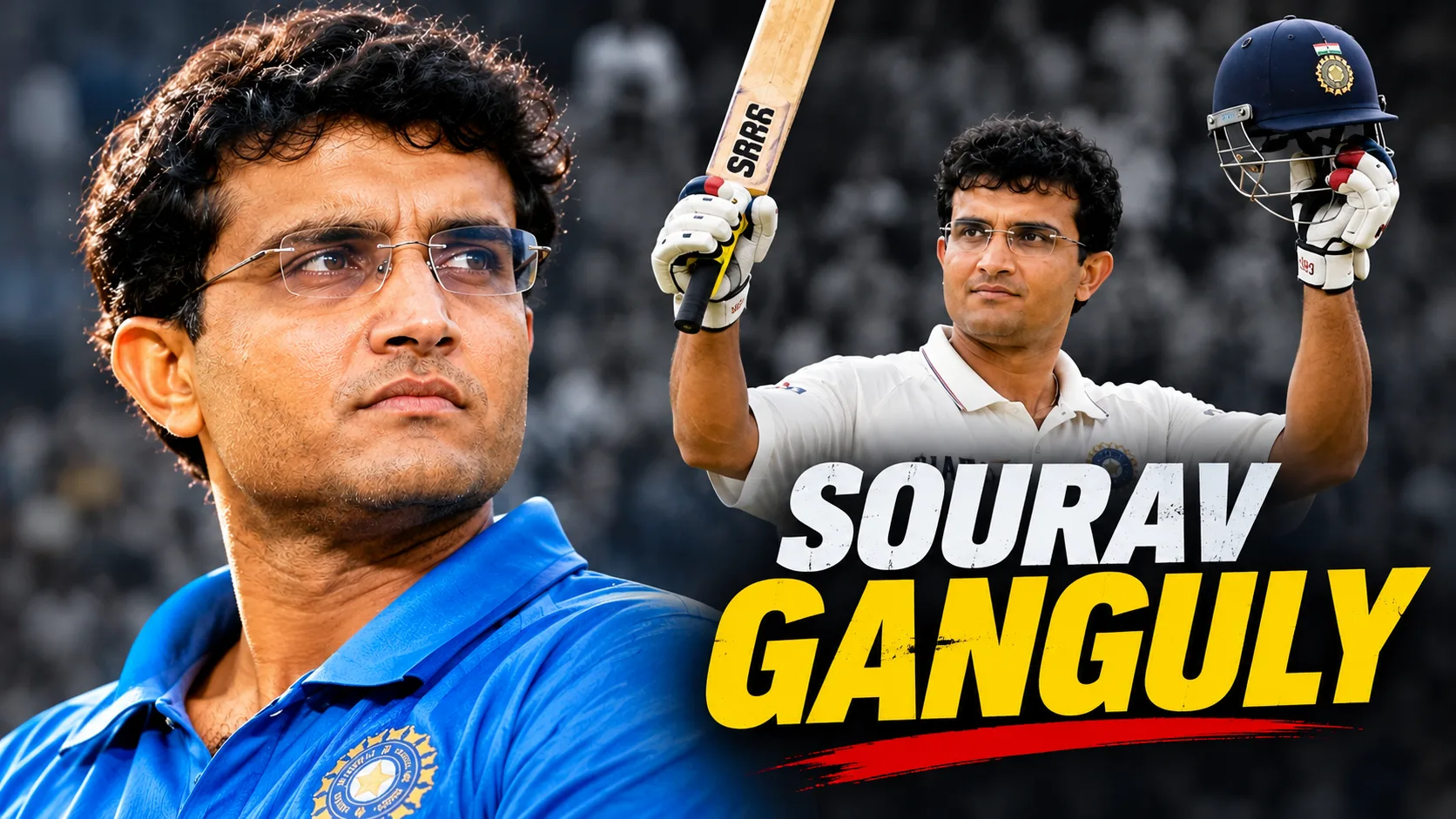
Sourav Ganguly is not just a name in Indian cricket, he is an emotion. Known as Dada, Prince of Kolkata, and God of the Off Side, Ganguly changed the way India played cricket.
He was the captain who taught India how to win abroad, how to fight back, and how to believe in young players. From a century on Test debut at Lord's to leading India to the 2003 World Cup final, his journey is one of the most inspiring stories in Indian cricket.
sourav ganguly's early life and family
Sourav Chandidas Ganguly was born on 8 July 1972 in Kolkata, West Bengal, in a wealthy Bengali family. His father Chandidas Ganguly ran a flourishing printing business, which was one of the largest in Asia at that time.
Cricket was already there in his home. His elder brother Snehasish Ganguly played first-class cricket for Bengal. Sourav grew up watching him, and that is where his love for cricket started.
In his childhood, Sourav was actually a right-handed batsman. But because he wanted to use his elder brother's left-handed cricket kit, he started batting left-handed. Later, that same left-handed batting became his identity.
He studied at St. Xavier's Collegiate School, Kolkata, where his talent was noticed at a very young age.
How the cricket career began
Ganguly's cricket career moved fast during his school days. Playing for St. Xavier's School, Kolkata, he showed his batting talent at a very young age. After scoring a century against the Odisha Under-15 team, he was made the captain of his school team — that is where his identity started building.
After that, he joined the Ashram Cricket Coaching Centre, which was run by the Aryans Club of Kolkata. In his early days, coaches like Debu Mitra played a big role in shaping his talent.
His elder brother Snehasish also played an important role in his journey. Snehasish himself was a Bengal first-class cricketer, and his career inspired his younger brother a lot.
His first big performance in junior cricket was a century against the Odisha Under-15 team. After that, he was selected for the Bengal junior team. At the age of 15, he became a part of the Bengal junior team, and during this period his performances at junior level started getting noticed at the national level too.
After that, he got a place in the Bengal senior team. In the 1989-90 Ranji Trophy, at the age of 17, he made his first-class debut for Bengal. His first match was not a normal league match, but the Ranji Trophy final against Delhi. In that match, Bengal won the title. Ganguly later called this debut one of the most memorable early moments of his career.
After his Ranji debut, he performed consistently in domestic cricket. In the 1990-91 Ranji Trophy season, his performance for Bengal was quite strong, which made his batting talent and consistency even more clear. This strong domestic performance later took him to the doors of the Indian team.
sourav ganguly's international career
Sourav Ganguly made his ODI debut in Brisbane. That match was not against Australia, but against West Indies. On 11 January 1992, in that match, he scored only 3 runs and got out. After that early match, he was dropped from the Indian team and had to wait for almost four years for his comeback in international cricket. In the 1996 England tour, he got another chance, and from there the most important phase of his international career started.
In June 1996, he made his Test debut against England at Lord's. In his very first Test, he scored 131 runs and grabbed everyone's attention. After that, in the next Test at Trent Bridge, he scored 136 runs. This start of scoring centuries in two consecutive Test innings remained one of the most memorable starts of his international career — he became the first Indian to score centuries in his first two Test innings.
In the 1999 World Cup, Ganguly was one of the main batsmen of the Indian team. His 183-run innings against Sri Lanka at Taunton is still remembered as one of the biggest individual innings by an Indian in the Men's ODI World Cup. In that innings, he hit 17 fours and 7 sixes off 158 balls, and shared a 318-run partnership with Rahul Dravid — Dravid scored 145 in that match.
After 2000, Ganguly became the captain of the Indian team, and under his leadership, the team started playing with confidence even in overseas conditions. India's historic Test series win against Australia at home in 2001 and the memorable chase in the NatWest Trophy final against England in 2002 remain among the most talked-about moments in Indian cricket.
In 2003, under Ganguly's captaincy, India reached the final of the ICC Cricket World Cup. After early setbacks, the Indian team won matches continuously to reach the final. Despite losing to Australia in the final, this tournament remained one of the most important chapters of Ganguly's captaincy career.
Ganguly also captained the Indian team on the 2003-04 tour of Australia. His 144-run innings in Brisbane gave India a strong position at the start of the series, and after India's historic win in the Adelaide Test, the team ended the four-match series at 1-1. This tour is considered a symbol of India's growing confidence in overseas conditions.
In 2008, Ganguly retired from international cricket. In his 16-year international career, he led Indian cricket through a phase in which the team learned to challenge abroad and many young players got a platform to grow. His batting, aggressive captaincy, and performances in big matches made his legacy in Indian cricket special.
IPL and domestic cricket
After his international career, Sourav Ganguly also made his presence felt in the IPL. He joined Kolkata Knight Riders (KKR) from the very start of the IPL in 2008 and became the team's icon player and captain. In the first IPL in 2008, his price was around 1.09 million US dollars. His association with KKR lasted from 2008 to 2010. In 2009, the captaincy of the team was with Brendon McCullum, while Ganguly was made KKR captain again in 2010.
After 2010, Ganguly was no longer a part of the KKR team. In the 2011 IPL auction, no franchise bought him, but during the tournament, Pune Warriors India included him as a replacement for Ashish Nehra. His price was 400,000 US dollars. In 2012, Pune retained him at the same price and made him the team's captain and mentor. In that season, he led Pune in the absence of Yuvraj Singh.
In domestic cricket, Ganguly's main association remained with Bengal. He started his first-class cricket for Bengal in the 1989-90 Ranji Trophy final against Delhi, and in the same match, Bengal won the title. Even after retiring from international cricket, he continued to play domestic cricket for Bengal. In the 2011-12 Ranji Trophy, he was once again representing Bengal, and he himself called the Ranji Trophy an important platform of his cricket career.
In this way, Ganguly's IPL journey which started with KKR reached Pune Warriors, while in domestic cricket, Bengal remained the most important team of his career.
Playing style
The biggest identity of Sourav Ganguly's batting was his brilliant off-side play. This left-handed batsman was known for playing extremely beautiful strokes on the off-side, and that is why he was called the 'God of the Off Side'. Cover drive, square drive, and his ability to send the ball into the gaps on the off-side were the special strengths of his batting. In his technique, both timing and beauty of the shot were visible.
Another special quality of Ganguly was his confidence and aggressive mindset. Against fast bowlers, he did not hesitate to come on the front foot and play shots, and when the ball came into his favourite area, he tried to put pressure on the bowler. While batting at the top of the order in ODI cricket, his style was especially effective. His opening partnership with Sachin Tendulkar also played an important role in giving India a fast start — both scored 6609 runs in 136 innings as openers, which is the highest by any opening pair in ODIs.
Ganguly was not limited to batting only. He also bowled right-arm medium pace and proved to be a useful option for the captain when needed. In his bowling, line, length, and variation were more important than pace. On many occasions, he used his medium-pace bowling to break partnerships.
Especially when the pitch was easy for batsmen and the team needed an extra bowling option, Ganguly's bowling could prove useful. In the 1998 Eden Gardens Test against Australia, he took important wickets while bowling with the new ball — in that match, he recorded figures of 3/28 in 13.4 overs with 5 maidens, which remained the best bowling performance of his Test career.
Overall, Ganguly's game was a combination of his attractive left-handed batting, brilliant off-side strokes, aggressive mindset, and medium-pace bowling when needed. This combination made him one of the most different and influential Indian cricketers of his era.
Achievements and records
Among Sourav Ganguly's biggest achievements is preparing the Indian team as a strong and confident unit. Under his captaincy, India won the joint winner title with Sri Lanka in the 2002 ICC Champions Trophy and reached the final of the 2003 ICC Cricket World Cup. Ganguly also captained the Indian team that reached the final of the 2000 ICC Champions Trophy.
The historic Test series win against Australia in 2001 and the memorable final win against England in the 2002 NatWest Series are counted among the biggest achievements of Ganguly's captaincy career. In the 2003 World Cup, under his captaincy, India won eight matches in a row to reach the final.
At the batting level too, Ganguly made many memorable records. His 183-run innings against Sri Lanka in the 1999 World Cup remained the biggest individual score by an Indian batsman in the Men's World Cup at that time. In the same World Cup, he scored 379 runs in 7 matches — the highest runs for India in that tournament were scored by Rahul Dravid, with 461 runs.
Scoring a century on debut at Lord's in Test cricket and then scoring a century in the next Test as well is included in the historic achievements of his career. He is among the select batsmen who scored centuries in the first two innings of their Test career.
Another special achievement of Ganguly was that he completed more than 11,000 runs in ODI cricket along with 100 ODI wickets and 100 catches. According to the ICC, he is among the select players who made the unique record of 10,000 runs, 100 wickets, and 100 catches in ODI cricket.
Talking about personal honours, Ganguly received the Arjuna Award in 1997. His name is recorded in the official list of the Government of India among the cricket award winners of that year.
In 2026, Ganguly was inducted into the ICC Cricket Hall of Fame. This honour is a recognition of his 16-year international career, his batting achievements, and his long impact of leadership in Indian cricket.
Because of these achievements, Ganguly's identity did not remain limited to just a successful batsman or captain. He played an important role in laying the foundation of an era in Indian cricket, in which the team started playing with confidence in big overseas matches, and later many players who emerged under his captaincy strengthened the next generation of Indian cricket.
Personal life
Sourav Ganguly is married to Indian classical dancer Dona Ganguly. Both were childhood friends and got married in 1997 — their formal wedding took place in February 1997. Dona is known for Odissi dance and she took training from the famous guru Kelucharan Mohapatra. This couple has a daughter, Sana Ganguly, who was born on 3 November 2001.
Ganguly's family has also been connected with cricket. His elder brother Snehasish Ganguly has played first-class cricket for Bengal and later got associated with cricket administration. His father Chandidas Ganguly was associated with the printing business.
In 2018, Ganguly published his autobiography A Century Is Not Enough, which he wrote with Gautam Bhattacharya. This book was published on 24 February 2018, in which he shared his experiences related to his cricket career, overseas tours, World Cup, and IPL. This book is an important public source to understand his playing life from his own perspective.
Many profiles related to Ganguly appear on social media, but without clearly verifying his official identity, it would not be appropriate to call any account official. Therefore, unverified social media handles have not been included in this biography.
On social media, Ganguly's official Instagram account is @souravganguly. He made his Instagram debut on 8 July 2019, on his 47th birthday.
In 2026, Ganguly was inducted into the ICC Cricket Hall of Fame. This honour is also a global recognition of his long impact on Indian cricket along with his cricket career.
Frequently asked questions
When and where was sourav ganguly born?
Sourav Ganguly was born on 8 July 1972 in Kolkata (then Calcutta), West Bengal, India.
Which team does sourav ganguly play for?
Sourav Ganguly does not play for any team now. He is retired. Earlier, he played for India (1992-2008), Bengal (1989-2012), Kolkata Knight Riders (2008-2010), and Pune Warriors India (2011-2012). His last team was Pune Warriors India in IPL 2012.
When did sourav ganguly make the international debut?
Sourav Ganguly ne 2 tarah se international debut kiya tha: 1. ODI Debut: 11 January 1992, Brisbane me West Indies ke khilaf. Us match me wo sirf 3 run bana ke out hue the. 2. Test Debut: 20 June 1996, Lord's me England ke khilaf. Pehle hi Test me unhone 131 run ki shandaar pari kheli thi.