Sachin Tendulkar Biography: Age, Family, Career and Records



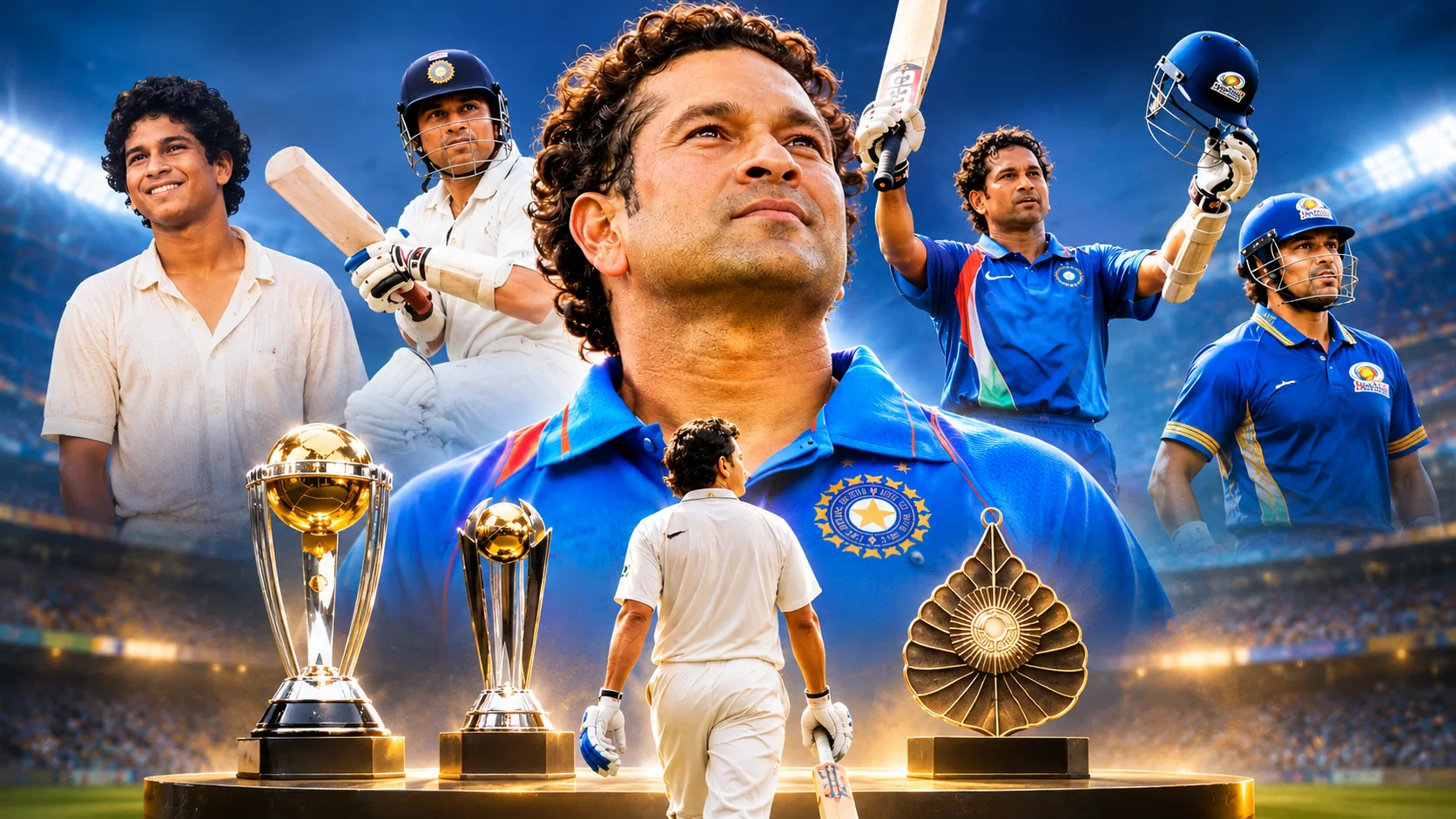
Sachin Tendulkar is a former Indian international cricketer who represented India in Test and ODI cricket for 24 years. A right-handed batter, he is known for scoring 100 international centuries and becoming the first player to score a double century in men's ODI cricket. He also represented Mumbai in domestic cricket and played for Mumbai Indians in the IPL.
Sachin Tendulkar's early life and family
Sachin Tendulkar was born on 24 April 1973 at Nirmal Nursing Home in Dadar, Mumbai, Maharashtra. His father, Ramesh Tendulkar, was a Marathi writer, poet and professor, while his mother, Rajni Tendulkar, worked in the insurance industry. Sachin was the youngest of four children. His elder siblings are Nitin, Ajit and Savita. His father named him after his favourite music director, Sachin Dev Burman.
Sachin grew up in the Sahitya Sahawas housing society in Bandra East. As a child, he enjoyed both cricket and tennis and admired American tennis player John McEnroe. His elder brother Ajit noticed his interest in cricket and introduced him to coach Ramakant Achrekar at Shivaji Park in 1984. Sachin did not bat naturally during his first trial because he felt nervous while the coach watched him. Ajit requested another chance and asked Achrekar to observe from behind a tree. Sachin played more freely in the second attempt and earned a place in the coach's training group.
He initially studied at Indian Education Society's New English School in Bandra. Achrekar later advised the family to move him to Sharadashram Vidyamandir in Dadar, which had stronger cricket facilities and a competitive school team. Sachin's father agreed to the change after discussing it with him. To manage the demanding practice schedule at Shivaji Park, Sachin later stayed with his uncle and aunt in Dadar.
Achrekar trained him at Shivaji Park, often arranging practice sessions in the morning and after school. One of the coach's methods was to place a one-rupee coin on the stumps: if Sachin remained unbeaten through the session, he could keep it. Sachin later recalled winning 13 such coins, which he continued to value as reminders of his early training.
How the cricket career began
Sachin Tendulkar's cricket training began under Ramakant Achrekar at Shivaji Park in Mumbai in 1984. Achrekar worked on his batting technique and match preparation, regularly arranging practice sessions and local matches. Sachin trained at the coach's cricket academy and attended Sharadashram Vidyamandir, where he got opportunities to play competitive school cricket.
His first major breakthrough came in February 1988 during the Harris Shield inter-school tournament. Playing for Sharadashram Vidyamandir alongside Vinod Kambli, Sachin scored an unbeaten 326, while the pair added 664 runs for the third wicket against St. Xavier's. Their partnership became a world record in competitive cricket at the time and brought national attention to both young batters.
Sachin was selected for Bombay's Ranji Trophy squad in 1987, but did not get a place in the playing eleven that season. On 11 December 1988, he made his first-class debut against Gujarat at the age of 15 and scored an unbeaten century. He became the youngest Indian to score a century on first-class debut. He later represented Mumbai in the Ranji Trophy and also played for Rest of India in the Irani Trophy and West Zone in the Duleep Trophy.
Sachin also represented Mumbai in the BCCI's Under-15, Under-17 and Under-19 age-group competitions. However, his early rise was driven more by school and senior domestic cricket than by a major Under-19 World Cup campaign. His performances in the Harris Shield and Ranji Trophy brought him into contention for India's senior team while he was still a teenager.
Sachin Tendulkar's international career
Sachin Tendulkar made his Test debut against Pakistan on 15 November 1989 in Karachi, aged 16. He faced a bowling attack featuring Imran Khan, Wasim Akram and Waqar Younis. During the same tour, he made his ODI debut against Pakistan in Gujranwala in December 1989. His first major breakthrough in Test cricket came against England at Old Trafford in 1990, when he scored his maiden Test century and helped India secure a draw.
The 1996 Cricket World Cup was an important stage in Tendulkar's career. He scored centuries against Kenya and Sri Lanka and finished as the tournament's leading run-scorer. Two years later, his performances against Australia during the 1998 Sharjah tournament attracted worldwide attention. His back-to-back centuries against Australia, including the famous innings known as the Desert Storm, helped India win the Coca-Cola Cup.
One of his most remembered World Cup performances came against Pakistan in the 2003 Cricket World Cup at Centurion. Tendulkar attacked the Pakistani fast bowlers and helped India chase the target. He later described that innings as one of the most memorable of his career. India reached the final of the tournament but lost to Australia.
Tendulkar's final major tournament achievement came at the 2011 Cricket World Cup, played in India, Sri Lanka and Bangladesh. He scored centuries during the tournament and finished as India's leading run-scorer. India defeated Sri Lanka in the final at Mumbai's Wankhede Stadium, giving Tendulkar his first World Cup title after several appearances in the competition. He retired from ODI cricket in 2012 and played his final Test against West Indies in Mumbai in November 2013.
IPL and domestic cricket
Sachin Tendulkar played all six seasons of the IPL, from 2008 to 2013, for Mumbai Indians (MI). He made his IPL debut on 14 May 2008 against Chennai Super Kings at Wankhede Stadium in Mumbai. He had missed the franchise's first seven matches of the inaugural season because of a groin injury. In his debut match, he scored 12 runs. His final IPL appearance also came at Wankhede, against Sunrisers Hyderabad on 13 May 2013.
Tendulkar was Mumbai Indians' icon player and first captain. He was not purchased through the regular auction. His initial contract was reported at approximately ₹5.16 crore in 2008. His salary later increased, and he was retained by the franchise for subsequent seasons. In 2010, he led Mumbai Indians to their first IPL final, where they lost to Chennai Super Kings. He stepped down from captaincy before the 2012 season, with Harbhajan Singh taking over.
His final IPL season in 2013 ended with Mumbai Indians winning their first title. After the final against Chennai Super Kings, Tendulkar announced that he would not play another IPL season. He finished his IPL playing career with the same franchise he had represented from the beginning.
In domestic cricket, Tendulkar represented Mumbai in the Ranji Trophy and other domestic competitions. He also played for West Zone and Rest of India in domestic tournaments, while Yorkshire was his county cricket team in England.
Playing style
Sachin Tendulkar's batting was built around balance, quick footwork, timing and an early reading of the bowler's length. He could play both front-foot and back-foot shots without making unnecessary movements. His technique helped him handle fast bowling on bouncy pitches in Australia and South Africa, as well as spin on slower subcontinental surfaces.
The straight drive was Tendulkar's favourite shot. He confirmed this himself during an interview, saying, “My favourite shot is the straight drive.” His cover drive, back-foot punch and leg-side flick were also regular scoring options.
Tendulkar's upper-cut became another recognisable part of his batting. He developed the shot during India's 2002 Test tour of South Africa, when he faced Makhaya Ntini's short-pitched bowling in Bloemfontein. In a later Q&A, he explained that he had not specifically practised the shot; it came through instinct. He used the pace and bounce of the delivery to guide the ball over the slips towards third man.
He was particularly dangerous against fast bowlers when the pitch offered pace and bounce, because he could use the extra speed to play cuts, pulls and the upper-cut. Against spinners, he used his footwork to get forward or move back, depending on the length. His approach against Shane Warne was a clear example: Tendulkar often waited for the ball to turn before playing it, rather than attacking too early.
Achievements and records
Sachin Tendulkar's biggest team achievement came in the 2011 ICC Cricket World Cup. India defeated Sri Lanka in the final at Mumbai's Wankhede Stadium, giving Tendulkar the World Cup title after five previous appearances in the tournament. He finished as India's leading run-scorer in that campaign. He was also part of India's 2002 ICC Champions Trophy-winning team, which shared the title with Sri Lanka after the final was washed out.
His individual honours include the Bharat Ratna (2014), India's highest civilian award. He became the first sportsperson and, at the time, the youngest recipient of the honour. Earlier, he received the Arjuna Award, Rajiv Gandhi Khel Ratna, Padma Shri and Padma Vibhushan. The ICC named him Cricketer of the Year in 2010, and he was inducted into the ICC Cricket Hall of Fame in 2019. In 2025, BCCI presented him with the Col. C.K. Nayudu Lifetime Achievement Award.
Major Achievements at a Glance
ICC Cricket World Cup winner – 2011
ICC Champions Trophy joint winner – 2002
Bharat Ratna – 2014
Padma Vibhushan – 2008
Padma Shri – 1999
Rajiv Gandhi Khel Ratna – 1997–98
Arjuna Award – 1994
ICC Cricketer of the Year – 2010
ICC Cricket Hall of Fame – 2019
Col. C.K. Nayudu Lifetime Achievement Award – 2025
First cricketer to score 100 international centuries
First batter to score a double century in men's ODI cricket
Only player to have appeared in 200 Test matches
Highest run-scorer in both Test and ODI cricket
Player of the Tournament – 2003 Cricket World Cup
Personal life
Sachin Tendulkar married Anjali Mehta on 25 May 1995. The two first met in 1990 at Mumbai airport, when Sachin was returning from an international tour. Anjali was at the airport to receive her mother. At the time, Anjali was working as a doctor, while Sachin was beginning his international cricket career. In his autobiography Playing It My Way, Sachin wrote that Anjali supported his cricket career and took responsibility for the family after their marriage.
The couple have two children: daughter Sara Tendulkar, born in 1997, and son Arjun Tendulkar, born in 1999. Arjun followed his father's path into cricket and has represented Mumbai and Goa in domestic cricket. Sara has been associated with the Sachin Tendulkar Foundation, which works in areas including children's healthcare, education and sports.
Sachin is active on Instagram and X, where he shares cricket-related updates, family moments, birthday messages and posts about social initiatives. Anjali generally maintains a lower public profile and appears in family posts and public events rather than regularly sharing personal updates herself.
One interesting detail from Sachin's autobiography is that he and Anjali got engaged on 24 April 1994, his 21st birthday. Their wedding took place a year later, on 25 May 1995. Sachin has also written that Anjali helped him manage life away from cricket, allowing him to concentrate on his playing career.
Frequently asked questions
When and where was sachin tendulkar born?
Sachin Tendulkar was born on 24 April 1973 at Nirmal Nursing Home in Dadar, Mumbai, Maharashtra, India.
Which team does sachin tendulkar play for?
Sachin Tendulkar is a former Indian cricketer. He represented the Indian national team in international cricket and played domestic cricket for Mumbai. In the IPL, he played for Mumbai Indians. He is now retired from professional cricket.
When did sachin tendulkar make the international debut?
Sachin Tendulkar made his international debut on 15 November 1989, playing his first Test match against Pakistan in Karachi, at the age of 16.