Harbhajan Singh Biography: Age, Family, Career and Records



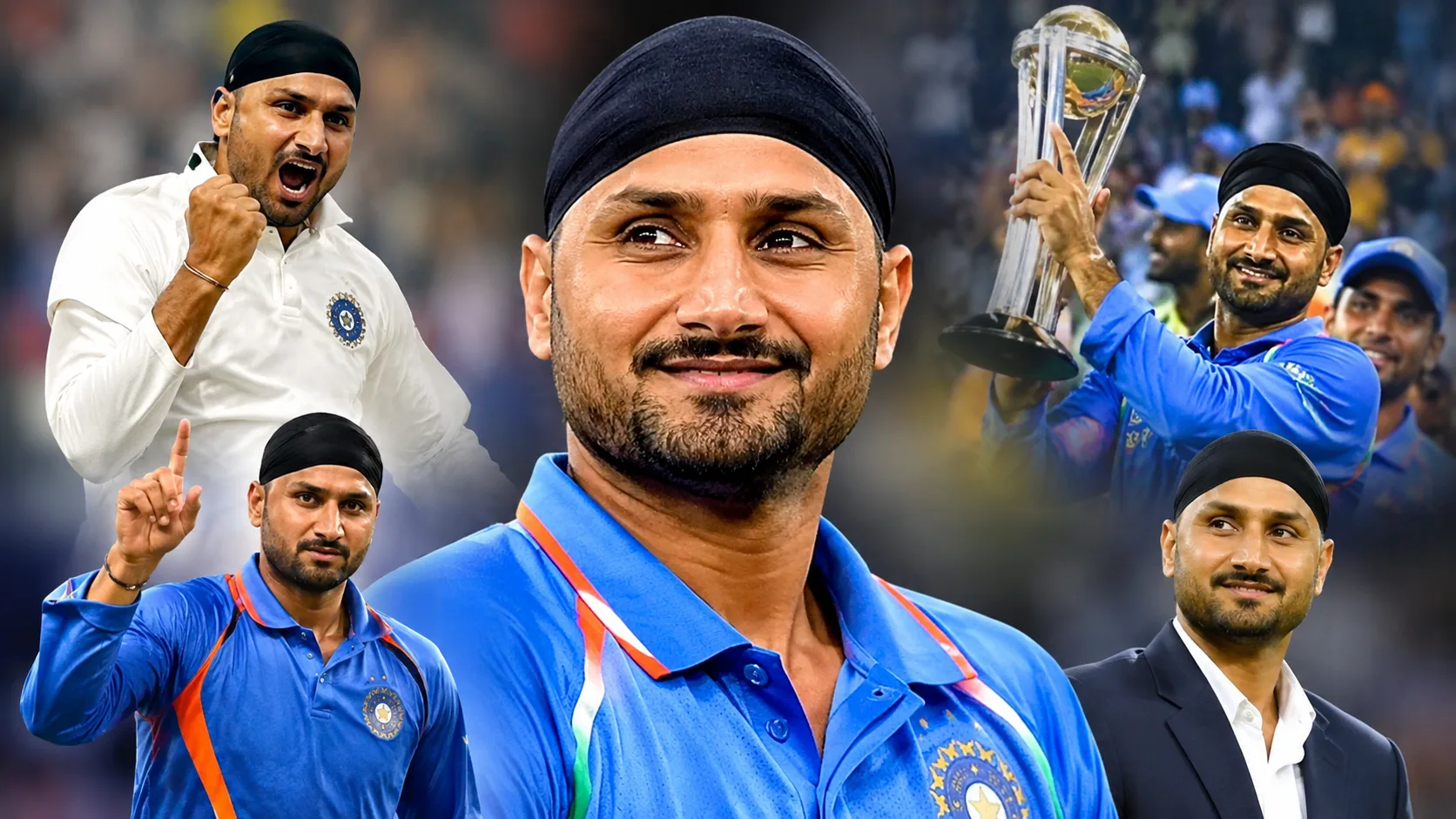
Harbhajan Singh Plaha, popularly known as Harbhajan Singh, is a former Indian cricketer who represented the Indian national team in all three formats. He was a right-arm off-spin bowler, best known for his sharp turn, doosra and match-winning performances, particularly during India's famous 2001 Test series against Australia.
Harbhajan Singh's early life and family
Harbhajan Singh was born on 3 July 1980 in Jalandhar, Punjab, India. His father's name was Sardar Sardev Singh Plaha, who ran a ball-bearing and valve manufacturing business, while his mother's name was Avtar Kaur. He was the only son in the family and grew up with five sisters. His father wanted him to focus on cricket and supported his dream of representing India, although the family also expected him to take care of their business in the future.
He completed his schooling in Jalandhar, where he attended Jai Hind Model School, Government Model Senior Secondary School, Doaba School and Parvati Jain High School. His interest in cricket developed at a young age, and he started playing in the local grounds of Jalandhar. His first coach, Charanjit Singh Bhullar, initially trained him as a batsman. After Bhullar's death, Davinder Arora took charge of his training and encouraged him to focus on off-spin bowling. That change proved important in shaping his future career.
At around 13, Harbhajan caught Arora's attention while playing street cricket. His natural bowling action, bounce and ability to turn the ball impressed the coach. He began training seriously under Arora and spent long hours practising. According to
The Indian Express
, he sometimes practised under the light of a scooter's headlamp when proper lighting was not available. Those early practice sessions in Jalandhar laid the foundation for his journey towards professional cricket.
How the cricket career began
Harbhajan Singh started his cricket training under Charanjit Singh Bhullar, who initially coached him as a batsman. After Bhullar's death, he began training under Davinder Arora, who encouraged him to focus on off-spin bowling. Arora spotted his talent when Harbhajan was around 13 years old and playing street cricket in Jalandhar. He was impressed by his unusual bowling action, bounce and ability to turn the ball. Harbhajan also trained at Burlton Park in Jalandhar, where his cricket journey began.
He made his mark in domestic cricket with Punjab's Under-16 team during the 1995-96 season. His first major performance came against Haryana, where he took 7 wickets for 46 runs in the first innings and 5 wickets for 138 runs in the second innings. Punjab won the match by nine wickets. He finished that season with 32 wickets in four matches and earned selection for the North Zone Under-16 team. His performances at the junior level helped him move quickly through the age-group system.
Harbhajan later represented Punjab Under-19 and also played for India's Under-19 team. In January 1998, he took part in the Under-19 World Cup in South Africa, where he claimed eight wickets in six matches. His best performance came against Kenya, where he took three wickets for just five runs. Before the tournament, he had already made his first-class debut for Punjab against Services in the 1997-98 Ranji Trophy season. His consistent performances in domestic and junior cricket brought him closer to the senior Indian team, and he made his Test debut against Australia in March 1998.
Harbhajan Singh's international career
Harbhajan Singh made his Test debut against Australia at Bengaluru in March 1998. He made his ODI debut against New Zealand in Sharjah the following month. His early international career had its share of challenges, but he gradually established himself as one of India's leading spin bowlers. He later made his T20 International debut against South Africa in Johannesburg.
The biggest turning point in his career came during the 2001 Test series against Australia. In the Kolkata Test at Eden Gardens, he became the first Indian bowler to take a Test hat-trick, dismissing Ricky Ponting, Adam Gilchrist and Shane Warne in consecutive deliveries. India went on to win the match after following on, making it one of the most memorable Test victories in Indian cricket history. Harbhajan continued his excellent bowling in the series, playing a major role in India's famous victory over Australia.
Harbhajan was also part of India's campaign in the 2003 Cricket World Cup, where the team reached the final. He later played an important role in India's historic triumph at the inaugural 2007 T20 World Cup in South Africa. His performance against Australia in the semi-final was particularly memorable, as he helped restrict their scoring during a crucial stage of the match.
Another major moment came during the 2011 Cricket World Cup, when India lifted the trophy on home soil. Harbhajan was part of the team throughout the tournament and contributed with his off-spin bowling. He also represented India in several editions of the ICC Champions Trophy and Asia Cup, including the 2002 Champions Trophy, which India shared with Sri Lanka after rain disrupted both final matches.
Throughout his international career, Harbhajan played in some of India's most memorable victories, particularly against Australia. His performances during the early 2000s helped establish him as a key member of India's bowling attack under Sourav Ganguly's captaincy.
IPL and domestic cricket
Harbhajan Singh began his IPL journey with Mumbai Indians in the inaugural season in 2008. Mumbai bought him for approximately ₹3.4 crore at the auction. He spent the first decade of his IPL career with the franchise and became an important part of its bowling attack. During this period, he also got opportunities to lead the side. He captained Mumbai Indians in different matches, including the 2008 and 2012 seasons. Under his time with the franchise, Mumbai won their first IPL title in 2013.
In 2018, Harbhajan moved to Chennai Super Kings after being bought for ₹2 crore at the auction. He played under MS Dhoni and was part of the team that won the IPL title in his first season with the franchise. He continued with Chennai in 2019 before joining Kolkata Knight Riders in 2021. KKR bought him for ₹2 crore, making it his third and final IPL franchise.
In domestic cricket, Harbhajan represented Punjab and remained closely connected to his home state's cricket throughout his career. He played for Punjab in the Ranji Trophy and other domestic competitions. Although he never represented Punjab Kings in the IPL, he later expressed his desire to finish his IPL career with the franchise based in his home state.
Across his IPL career, Harbhajan represented Mumbai Indians, Chennai Super Kings and Kolkata Knight Riders, leaving his mark on three different franchises.
Playing style
Harbhajan Singh's biggest strength was his ability to trouble batters with turn, bounce and changes in pace. Unlike some traditional off-spinners, he preferred bowling with a little more pace and aggression. He was also good at using flight to tempt batters into playing attacking shots. His most famous delivery was the doosra, which turned away from right-handed batters instead of coming into them like a regular off-break. He developed this variation after watching Pakistan spinner Saqlain Mushtaq. Along with the doosra, his sharp off-break and arm ball made him difficult to read.
Harbhajan was particularly dangerous on pitches that offered some bounce and assistance to spin bowling. His ability to bowl long spells and keep landing the ball around the same area helped him build pressure on the opposition. He was also effective when attacking fields were set, with close-in fielders waiting for edges and bat-pad chances. His best example came during the 2001 Test series against Australia, where his turn, bounce and aggressive approach made life difficult for some of the world's best batters.
Beyond his bowling, Harbhajan could contribute useful runs in the lower order. He was not afraid to take on bowlers when the team needed quick runs, making him a valuable option in the longer format as well.
Achievements and records
Harbhajan Singh enjoyed a successful international career, winning several major tournaments with India. He was part of the Indian team that lifted the inaugural T20 World Cup in 2007 under MS Dhoni's captaincy. Four years later, he was also a member of the squad that won the 2011 ODI World Cup on home soil. He featured in India's 2002 ICC Champions Trophy-winning campaign, which ended with India and Sri Lanka sharing the trophy after rain disrupted the final. He also won the Asia Cup with India in 2010.
His achievements also earned him important national honours. In 2003, the Government of India presented him with the Arjuna Award for his contribution to cricket. In 2009, he received the Padma Shri, one of India's major civilian honours. He was also named Player of the Series during India's Test series against Australia, West Indies, South Africa and New Zealand at different stages of his career.
Harbhajan Singh's Major Records
First Indian Test hat-trick - He became the first Indian bowler to take a Test hat-trick during the famous Kolkata Test against Australia in 2001. His victims were Ricky Ponting, Adam Gilchrist and Shane Warne.
417 Test wickets - He finished his Test career with 417 wickets, placing him among India's most successful Test bowlers.
269 ODI wickets - He picked up 269 wickets in One Day Internationals, making him an important part of India's bowling attack for many years.
13 wickets in a Test match - His match figures of 13/196 against Australia in the 2001 Kolkata Test remain one of the most memorable bowling performances in Indian cricket.
25 five-wicket hauls - He recorded 25 five-wicket hauls in Test cricket, showing his ability to deliver match-changing spells.
Two Test centuries - Apart from his bowling, he also scored two Test centuries, both against New Zealand in 2010.
Harbhajan's contribution to Indian cricket went beyond his individual numbers. His performance against Australia in 2001 remains a major part of his legacy, while his role in India's World Cup victories made him part of two memorable generations of Indian cricket. His Test hat-trick and long record of taking wickets at the highest level will continue to be remembered by cricket fans.
Personal life
Harbhajan Singh married Bollywood actress Geeta Basra on 29 October 2015 in Jalandhar, Punjab. Their relationship developed over several years before they decided to get married. Geeta made her Bollywood debut with Dil Diya Hai in 2006 and later appeared in films such as The Train. Their wedding was attended by several personalities from cricket, Bollywood and their close family circles.
The couple has two children. Their daughter, Hinaya Heer Plaha, was born in July 2016, while their son, Jovan Veer Singh Plaha, was born in July 2021. Harbhajan occasionally shares family photographs and special moments with his children on social media. Despite spending much of his career travelling for cricket, he has often spoken about the importance of spending time with his family.
Harbhajan is active on Instagram and X, where he shares cricket-related opinions, personal photographs and updates about his public appearances. His Instagram account is @harbhajan3, while his X account is @harbhajan_singh. He also remains connected to cricket through television commentary and discussions about the game.
One interesting detail about Harbhajan's journey is that he did not initially plan to become an off-spinner. He started his cricket training as a batter, but his coach encouraged him to concentrate on spin bowling after recognising his natural ability. That decision eventually shaped his entire career. Another memorable part of his story is the 2001 Kolkata Test against Australia, where he became the first Indian bowler to take a Test hat-trick.
Frequently asked questions
When and where was Harbhajan Singh born?
Harbhajan Singh was born on 3 July 1980 in Jalandhar, Punjab, India. His full name is Harbhajan Singh Plaha.
Which team does Harbhajan Singh play for?
Harbhajan Singh represented the Indian national cricket team in international cricket. He also played domestic cricket for Punjab. He retired from all forms of professional cricket in December 2021.
When did Harbhajan Singh make the international debut?
Harbhajan Singh made his Test debut on 25 March 1998 against Australia in Bengaluru. He made his ODI debut against New Zealand on 17 April 1998 in Sharjah and his T20 International debut against South Africa on 1 December 2006 in Johannesburg.