Sunil Gavaskar Biography: Age, Family, Career and Records



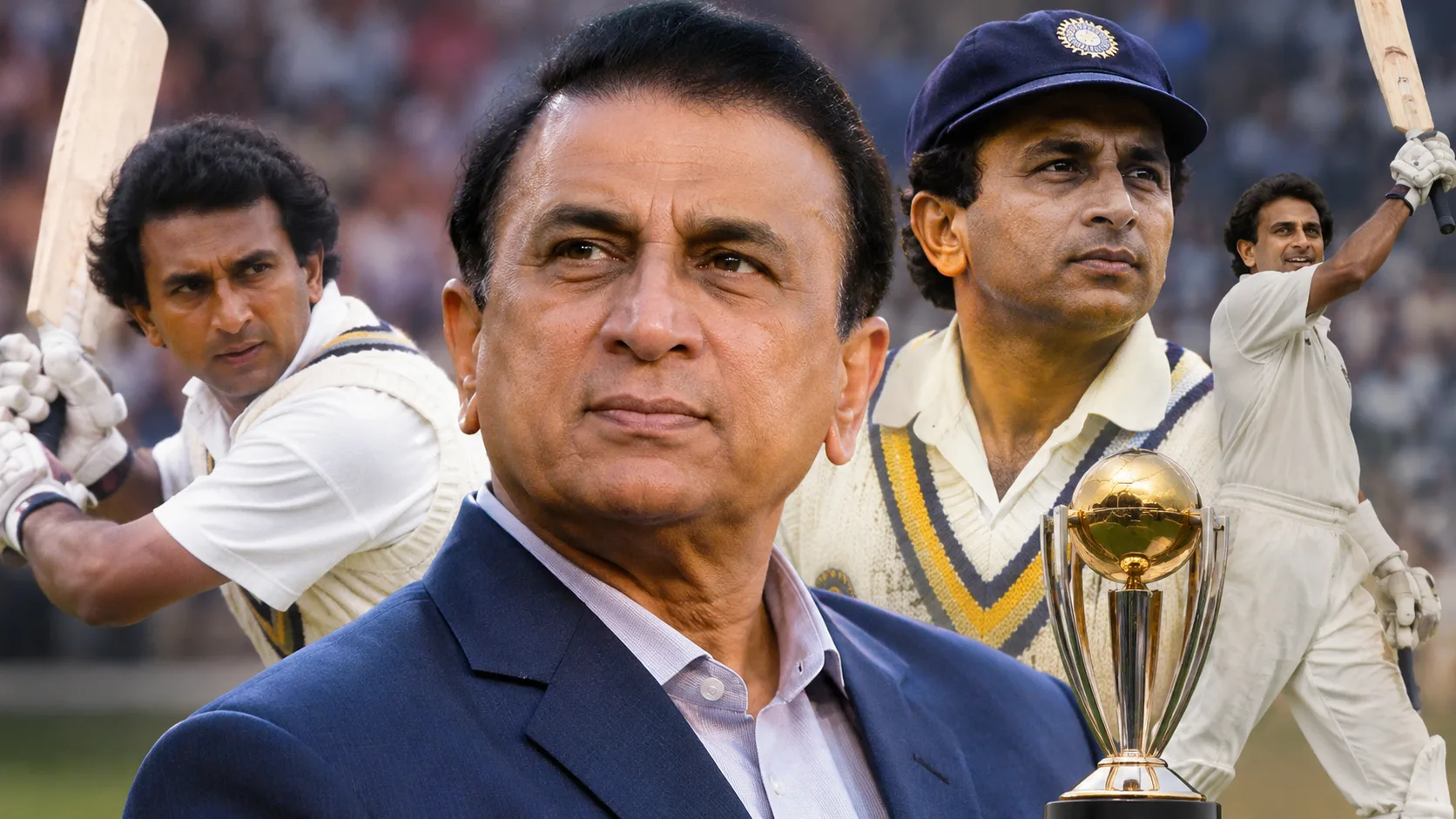
Sunil Manohar Gavaskar is a former Indian cricketer widely regarded as one of the finest opening batsmen in the history of the game. He represented India from 1971 to 1987 and became famous for his solid technique, remarkable concentration and ability to face some of the fastest bowlers of his era without a helmet. He was the first batter to score 10,000 runs in Test cricket and remains one of India's most respected cricket figures.
Sunil Gavaskar's early life and family
Sunil Gavaskar was born on 10 July 1949 in Bombay (now Mumbai), Maharashtra. His father, Manohar Gavaskar, was a club cricketer, while his mother, Meenal Gavaskar, also had a strong interest in the game. Cricket was part of everyday life in the family. His maternal uncle, Madhav Mantri, had represented India as a wicketkeeper, so Gavaskar grew up watching and discussing the sport from an early age.
His childhood was spent playing tennis-ball cricket in the narrow courtyard outside the family home. Space was limited, so he learned to keep the ball along the ground and play straight. His mother often bowled to him during their practice sessions. In his autobiography Sunny Days, Gavaskar recalled hitting a straight drive that struck his mother's nose and caused it to bleed. Even after the incident, she continued the game. That small episode offers a glimpse of how naturally cricket had become part of his childhood.
Gavaskar attended St. Xavier's High School in Bombay, where his batting began attracting attention beyond the school team. In 1966, he was named India's Best Schoolboy Cricketer of the Year. He later studied at St. Xavier's College and continued playing competitive cricket. His school captain, Milind Rege, once recalled how Gavaskar was promoted to open the batting in a school match against Anjuman Islam. The decision proved important: Gavaskar took to the new position and gradually made it his own.
There is also an unusual story from the day he was born. His uncle Narayan Masurekar noticed a small mark on the baby's earlobe when he visited the hospital. On a later visit, he found that the baby being held by the family did not have that mark. A search followed, and the infant was found in another part of the hospital. The family believed he had been accidentally exchanged with another newborn. It became one of the most unusual stories associated with Gavaskar's early life.
His first steps in cricket came through school and local matches, but the influence of his parents and uncle gave him an early understanding of the game. By his teenage years, he was already scoring heavily in school competitions and had earned a place in the Indian Schoolboys' team. The boy who once played in a small courtyard was now beginning to attract attention across Mumbai's cricket circles.
How the cricket career began
Sunil Gavaskar did not come through a formal cricket academy in the way many young players do today. Most of his early development happened through school cricket, local clubs and regular practice at Mumbai's Shivaji Park. In 1965, he attended a six-week BCCI coaching camp in Hyderabad under English coach T. S. Worthington. Gavaskar later recalled that the camp helped correct technical flaws and gave his batting a more structured approach.
His progress through school cricket was rapid. At the age of 13, he scored his first century in the Giles Shield, a major inter-school competition in Bombay. He continued to score heavily and, in 1966, was named India's Best Schoolboy Cricketer of the Year. That recognition brought him into the wider Mumbai cricket circuit. He also represented Indian Schools against touring London Schoolboys, scoring a century in his first innings.
Gavaskar made his first-class debut for Vazir Sultan Colts XI in the 1966–67 Moin-ud-Dowlah Gold Cup. His Ranji Trophy debut for Bombay came in the 1968–69 season against Karnataka. His first appearance did not go as planned, and questions were raised about his selection, partly because his uncle Madhav Mantri had been associated with the Mumbai cricket setup. Gavaskar answered those doubts with a century against Rajasthan in his next Ranji match. He followed it with more strong performances, making it difficult for selectors to overlook him.
There was no major Under-19 World Cup pathway in his playing days as there is now. Instead, school and university cricket served as the main route for young players to reach the senior domestic level. Gavaskar moved through that system, representing Bombay and later the West Zone. By the time India selected him for the 1970–71 tour of the West Indies, he had already shown that he could build long innings against experienced domestic attacks.
Sunil Gavaskar's international career
Sunil Gavaskar made his Test debut against the West Indies on 6 March 1971 at Queen's Park Oval in Port of Spain. He had missed the opening Test because of a finger injury, but once he entered the side, he made an immediate impression. Facing a strong West Indies attack led by some of the finest bowlers of that era, Gavaskar showed patience and confidence. His performances helped India secure its first-ever Test series victory in the Caribbean.
The final Test of that tour became one of the defining moments of his career. Gavaskar scored a century in the first innings and a double century in the second, finishing a remarkable debut series on a high note. His success against the West Indies attack established him as an international opener and gave Indian cricket a batter who could stand up to the world's fastest bowlers.
He made his ODI debut against England at Headingley on 13 July 1974. His early one-day career was less successful, and his slow innings against England in the 1975 World Cup attracted heavy criticism. Gavaskar later admitted that he had misunderstood the demands of the situation. His ODI story, however, had a different ending. In the 1987 World Cup, he scored a century against New Zealand in Nagpur, his only hundred in the format. He was also part of India's 1983 World Cup-winning team and captained the side that won the 1985 World Championship of Cricket in Australia.
His final Test appearance came against Pakistan in Bengaluru in March 1987, while his last ODI was against England later that year. Gavaskar left international cricket after a career in which he had faced some of the most feared fast-bowling attacks without the protective equipment commonly used by modern batters.
IPL and domestic cricket
Unlike modern cricketers, Sunil Gavaskar never played in the IPL. The tournament began long after his retirement, so he has no IPL team, auction price or franchise career to his name. During his playing days, his main domestic team was Bombay (now Mumbai), where he spent most of his first-class career. He also played county cricket for Somerset in England in 1980.
Gavaskar also captained India during different periods of his international career. His leadership became particularly noticeable in the 1985 World Championship of Cricket in Australia, where India won the tournament without losing a match. He was known for backing his bowlers and using spin effectively, even in conditions where fast bowling was generally considered the better option.
At the domestic level, Bombay remained the team most closely associated with him. His performances in the Ranji Trophy helped establish his reputation before he became an international cricketer, and he continued representing the side until the later stages of his career.
Playing style
Sunil Gavaskar's greatest strength was his technique against fast bowling. He had excellent balance at the crease, quick footwork and the patience to leave deliveries outside the off stump. At a time when helmets were not commonly used, he faced some of the quickest bowlers in the world with remarkable composure. His ability to read the length early and move into the right position made him particularly difficult to dismiss.
The straight drive was his favourite shot. He once explained that he preferred it because it allowed him to present the full face of the bat. His on-drive and cover-drive were equally effective, while the late cut showed his touch and timing. Former India opener Chetan Chauhan also singled out Gavaskar's straight drive and on-drive as two of the finest shots in his batting.
Gavaskar was at his most dangerous when the opposition tried to dominate him with pace or put pressure on India early in an innings. He rarely rushed into attacking shots. Instead, he made bowlers work for every wicket, gradually wearing them down before punishing loose deliveries. His long innings against the West Indies and England showed that he could remain at the crease for hours without losing concentration. Even on difficult pitches, his defence and judgement of the ball gave him a way to survive and build an innings.
Achievements and records
Sunil Gavaskar's place in cricket history was built on performances against some of the strongest bowling attacks of his era. His first tour of the West Indies in 1971 announced his arrival, but he continued to deliver for India over the next sixteen years. He became the first batter to cross 10,000 runs in Test cricket, a landmark that had seemed out of reach when he began his career. He also finished with 34 Test centuries, a record that stood until Sachin Tendulkar moved past it.
His achievements were recognised with some of India's highest sporting and civilian honours. Gavaskar received the Arjuna Award in 1975 and the Padma Bhushan in 1980. The same year, he was named one of Wisden's Cricketers of the Year. He was inducted into the ICC Cricket Hall of Fame in 2009, and the BCCI honoured him with the Col. C. K. Nayudu Lifetime Achievement Award in 2012. The Border-Gavaskar Trophy, contested between India and Australia, also carries his name alongside Australian great Allan Border.
A look at Sunil Gavaskar's notable records and honours
First batter to score 10,000 runs in Test cricket.
Finished his Test career with 10,122 runs and 34 centuries.
Scored 774 runs on his first tour of the West Indies in 1971, a record for a debut series at the time.
First player to score 30 centuries in Test cricket.
First Indian fielder to take 100 catches in Test matches.
Member of India's 1983 World Cup-winning team.
Led India to the 1985 World Championship of Cricket title.
Received the Arjuna Award in 1975.
Awarded the Padma Bhushan in 1980.
Named Wisden Cricketer of the Year in 1980.
Inducted into the ICC Cricket Hall of Fame in 2009.
Received the Col. C. K. Nayudu Lifetime Achievement Award in 2012.
His records are only part of the story. Gavaskar showed that an Indian opening batter could stand firm against the fastest bowlers in the world and build an entire career around technique, discipline and concentration. That example influenced generations of Indian batters who followed him.
Personal life
Sunil Gavaskar married Marshneil Mehrotra on 23 September 1974. The two first met in Delhi during a cricket match in 1973, when Marshneil approached him for an autograph. Their meeting eventually turned into a relationship, and they married the following year. Gavaskar has one son, Rohan Gavaskar, who was born on 20 February 1976 and later went on to represent India in international cricket.
One interesting detail about their family is the name given to their son. Gavaskar named him Rohan in honour of West Indies batting great Rohan Kanhai, one of his childhood cricket heroes. Away from the field, Gavaskar has generally kept his family life private. He remains publicly active through cricket commentary, interviews and media appearances, but there is no clearly established official personal social media account that can be confidently attributed to him
Frequently asked questions
When and where was Sunil Gavaskar born?
Sunil Gavaskar was born on 10 July 1949 in Bombay (now Mumbai), Maharashtra, India.
Which team does Sunil Gavaskar play for?
Sunil Gavaskar is a retired Indian cricketer. During his playing career, he represented Bombay (now Mumbai) in domestic cricket and Somerset in English county cricket. He also captained the Indian national team.
When did Sunil Gavaskar make the international debut?
Sunil Gavaskar made his Test debut on 6 March 1971 against the West Indies at Queen's Park Oval in Port of Spain, Trinidad.