DLS Method in Cricket: How Duckworth-Lewis-Stern Rule Works



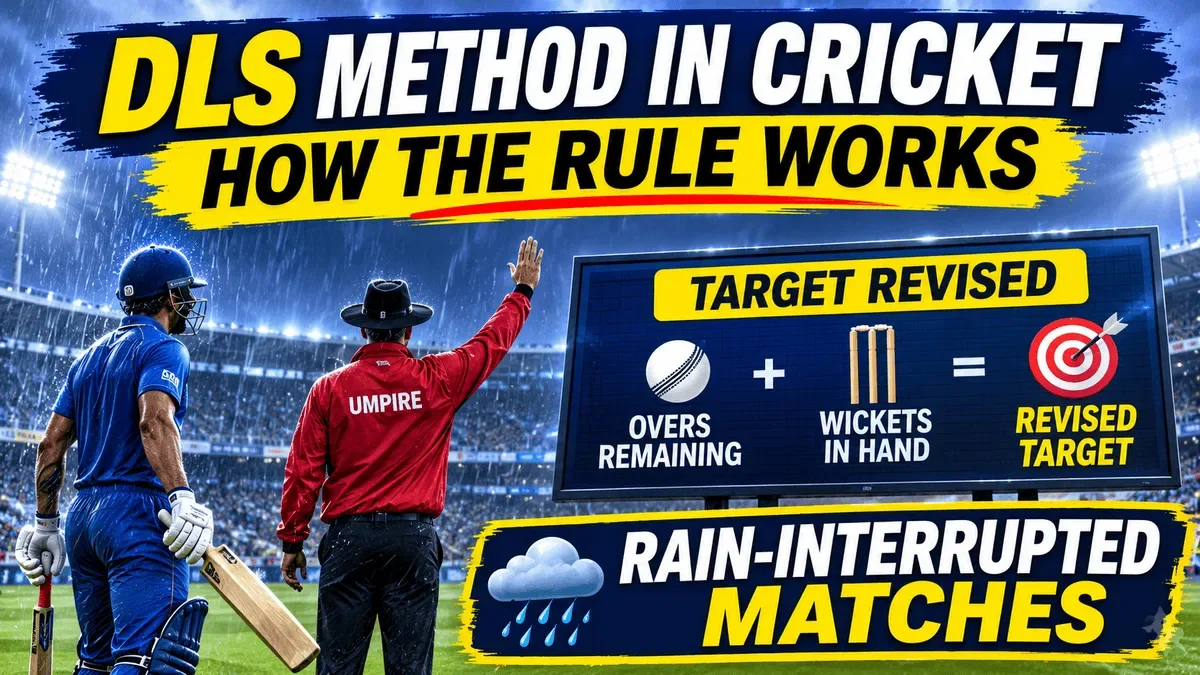
The Duckworth-Lewis-Stern method is a key rule within limited-overs cricket. It is used if there is bad weather or other issues which cause a reduction in the number of overs in a match.
Whilst people often see amended scores on a cricket scoreboard following bad weather, many people are unaware of the process behind this. The method assesses the scoring potential of the two teams in order to decide a new target for the team batting second.
It can be applied in both international and domestic limited-overs cricket, according to the prevailing conditions.
What Is the DLS Method in Cricket?
DLS is short for Duckworth-Lewis-Stern. This method is mathematical and is used to calculate a new target for a team in a limited-overs match that has been affected by bad weather.
Its calculations are based on:
- Overs left – the number of overs that remain for a team to bat.
- Wickets left – the number of wickets that a team has left.
This information assists in establishing a team's scoring potential. If a team has had their number of overs reduced due to bad weather then it may be necessary to amend the target in order to ensure a fair contest.
In 1999 the International Cricket Council (ICC) officially recognised the Duckworth-Lewis method. Steven Stern, an Australian statistician, was involved in further development and so the method became known as the Duckworth-Lewis-Stern method from 2014.
How Does the DLS Method Work?
As previously mentioned, unlike a basic method of simply amending the target in proportion to the number of lost overs, the DLS method takes into account the scoring potential of both teams.
A team with 8 wickets in-hand and 15 overs to bat will typically have greater scoring potential than a team who only has 2 wickets and 15 overs.
Whereas a match is in progress and bad weather occurs, DLS works out the extent to which each team’s scoring potential has been affected. Then, according to the contrasting scoring potential of the two teams, a new target is decided for the team batting second. Usually this is carried out via the official DLS programme.
What Factors Are Considered in the DLS Method?
Two key aspects are analysed during the DLS process.
1. Number of overs left
The number of overs a team has to bat clearly influences their scoring potential. Usually a reduction in the number of overs is detrimental to a team's scoring ability.
2. Wickets left
Similar to overs, having more wickets in-hand generally allows a team to continue to attack and thus score.
A team with 9 wickets is typically able to perform more effectively than one that has already lost 8 wickets. Both of these aspects are analysed in conjunction with each other.
Example of the DLS Method in Cricket
Imagine that Team A achieved a score of 250 in a 50 over match. Team B begins to bat but bad weather then causes disruption. Following the weather problem, Team B are only allocated 30 overs in which to bat.
Given that Team B have had a large number of overs removed, the initial target of 251 may not now be suitable.
By analysing the scoring potential of the teams, DLS decides upon a new target for the second batting team. This is dependent on the circumstances of the match.
As the new target is influenced by both pre and post disruption overs and wickets, it cannot be precisely determined using just the initial score and the reduced number of overs.
Why is DLS important?
DLS ensures that matches can continue in a fair manner despite bad weather disruption. Otherwise, the team batting second could be at an unfair disadvantage as they may have less overs in which to reach the initial target.
Taking into account the circumstances of a match, DLS analyses the scoring potential of each team and then modifies the target accordingly.
ODI and T20 cricket especially greatly benefits from the use of DLS as even a slight decrease in the number of overs can greatly influence the outcome of a match.
Who created the Duckworth-Lewis method?
Initially the Duckworth-Lewis method was devised by English statisticians Frank Duckworth and Tony Lewis. In 1999 the ICC officially recognised this method for international limited-overs cricket.
Subsequently, development and further enhancement of the method fell under the responsibility of another statistician, Steven Stern from Australia.
As a result of his involvement, the method was renamed the Duckworth-Lewis-Stern method from 2014.
Conclusion
Within matches affected by bad weather, DLS is an important tool. It analyses the overs and wickets of both teams in order to establish a new target.
Rather than simply altering the target in line with the number of overs lost, DLS analyses the scoring potential of teams to decide upon a fair new target. For this reason, DLS continues to be an important element of contemporary limited-overs cricket.
Explore More Analytical Articles



Frequently asked questions
What does DLS stand for in reference to cricket?
DLS is an abbreviation for Duckworth-Lewis-Stern. It is a mathematical approach which is used to establish new targets in limited-overs matches that have been disrupted.
Who devised the DLS method?
Whilst the original DLS method was devised by Frank Duckworth and Tony Lewis, Steven Stern was also involved in its development.
When was DLS introduced?
The ICC officially recognised the Duckworth-Lewis method in 1999.
Is DLS used in IPL matches?
Yes, DLS is applied within IPL matches if the number of overs available is decreased as a consequence of bad weather or other disruptions, in accordance with the prevailing conditions for the tournament.