Women's Cricket Fielding Positions Explained:


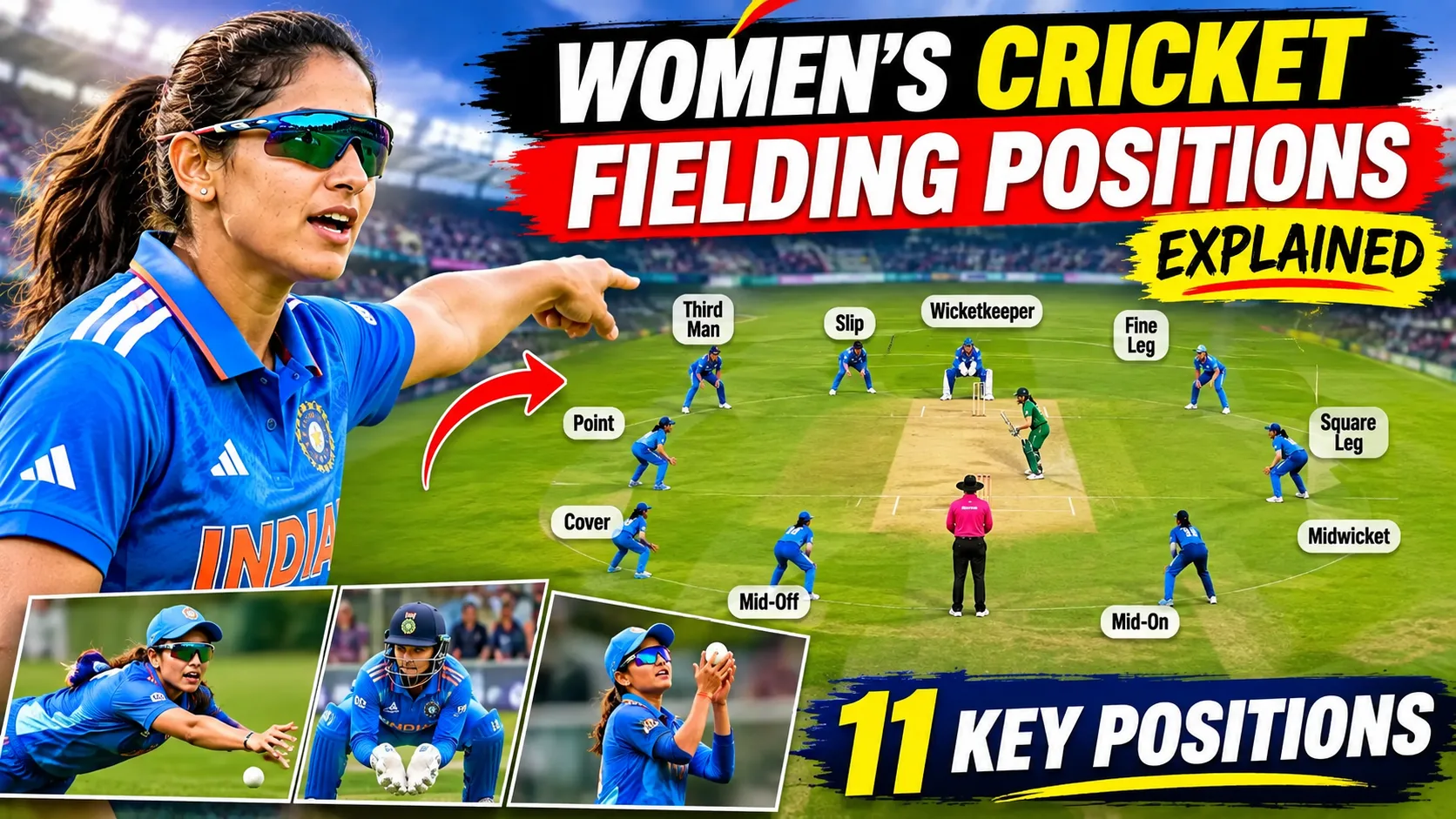
Understanding fielding positions makes women's cricket more interesting to watch. Every fielder has a specific place and role on the ground. Some players stop boundaries, while others stand close to the batter to catch edges. This guide explains the main cricket fielding positions in simple English.
Women's Cricket Fielding Positions Explained: Basic Field Layout
A cricket field is divided into two main sides: the off side and the leg side.
For a right-handed batter:
Off side: The side in front of the batter's body.
Leg side: The side behind the batter's legs.
For a left-handed batter, these sides are reversed.
The captain and bowler decide where to place fielders before each delivery. Their positions can change depending on the batter, bowling style, match situation and number of overs remaining.
Main Fielding Positions in Women's Cricket
There are several fielding positions in cricket. Each one has a different responsibility. Here are the most common positions beginners should know.
1. Wicketkeeper
The wicketkeeper stands directly behind the stumps. Their main job is to catch the ball when the batter misses it.
The wicketkeeper can also try to stump the batter if they move outside the crease. Quick reactions and good catching skills are important for this position.
2. Slip
Slip fielders stand beside the wicketkeeper on the off side.
Their job is to catch the ball when it takes an edge from the batter's bat. Captains may use one, two, three or even four slips, depending on the match situation.
Slips are especially useful when the ball is moving away from the batter.
3. Gully
Gully stands behind the batter on the off side, slightly wider than the slip fielders.
This player looks for edges that travel between the slip area and the point region. A gully fielder needs quick reactions and strong catching skills.
4. Point
Point is located on the off side, roughly square to the batter.
The point fielder stops cuts and square shots played towards the off side. This position is important in both T20 and One-Day cricket because batters often use the cut shot to score runs.
5. Cover
Cover stands on the off side, between point and mid-off.
This fielder stops drives played through the cover region. A strong cover fielder can save runs and prevent boundaries.
6. Extra Cover
Extra cover stands between cover and mid-off, slightly closer to the bowler.
This position is useful against batters who like to play attacking drives through the off side.
7. Mid-Off
Mid-off stands on the off side, closer to the bowler than cover.
The fielder tries to stop straight drives and shots played towards the off side. Captains often place a fielder here to control scoring through the front of the bat.
8. Mid-On
Mid-on is similar to mid-off but stands on the leg side.
This fielder stops straight shots played towards the bowler's leg-side region. Mid-on is often used when the batter likes to play on the front foot.
9. Midwicket
Midwicket stands on the leg side between mid-on and square leg.
This is an important position because many batters play flicks and shots across the line towards this area.
10. Square Leg
Square leg stands on the leg side, roughly square to the batter.
This fielder stops pulls, sweeps and shots played towards the leg side. The position can be close to the batter or near the boundary.
11. Fine Leg
Fine leg stands behind square leg on the leg side, closer to the boundary.
The fielder tries to stop balls that travel towards the fine leg region, including glances and deflections off the batter's pads or bat.
12. Third Man
Third man stands behind the batter on the off side, usually near the boundary.
This fielder protects against edges that travel past the slips and towards the third-man area. Third man is commonly used in limited-overs cricket.
Boundary Fielding Positions in Women's Cricket
In T20 and One-Day cricket, boundary fielders play an important role. Their main responsibility is to stop fours and catch shots that travel high in the air.
Here are some common boundary positions:
| Fielding Position | Main Responsibility |
|---|---|
| Long-Off | Stops straight shots towards the off side |
| Long-On | Covers straight shots on the leg side |
| Deep Midwicket | Protects the leg-side boundary between midwicket and square leg |
| Deep Square Leg | Stops pulls and shots played towards square leg |
| Deep Cover | Protects the boundary in the cover region |
| Deep Point | Stops cuts and square shots on the off side |
| Deep Fine Leg | Covers the fine leg boundary |
| Deep Third Man | Stops edges and shots behind the batter on the off side |
| Deep Extra Cover | Protects the boundary between cover and long-off |
| Cow Corner | Covers the area between deep midwicket and long-on |
These positions become especially important when batters start attacking in the final overs.
Close-In Fielding Positions
Some fielders stand very close to the batter. These positions are mostly used to create pressure and catch shots played softly or along the ground.
Silly Point
Silly point stands very close to the batter on the off side, near the pitch.
The fielder tries to catch defensive shots that pop up from the bat or pad. Protective equipment is important because the ball can travel quickly from this distance.
Short Leg
Short leg stands close to the batter on the leg side.
This fielder looks for catches from balls that hit the bat or pad and travel into the air. It is a common position in longer formats of cricket.
Leg Slip
Leg slip stands behind the batter on the leg side, close to the wicketkeeper.
The position is used to catch edges that travel towards the leg side, often from balls played off the pads or bat.
Silly Mid-On and Silly Mid-Off
These are close fielding positions on the leg side and off side respectively.
They are used when the captain wants to put pressure on the batter and create chances for catches.
How Do Fielding Positions Change in T20, ODI and Test Cricket?
Fielding positions are not fixed. Captains change them according to the format, bowler and batter.
T20 Cricket
In T20 matches, batters often try to score quickly. Captains usually place more fielders near the boundary to stop big shots.
Positions such as deep midwicket, long-on, long-off and deep cover are commonly used. Close fielders may also be placed inside the circle to create catching chances.
One-Day Cricket
One-Day cricket needs a balance between attacking and defensive fielding.
Captains may keep some players near the boundary while using others inside the circle to stop singles. The fielding plan often changes between the powerplay, middle overs and final overs.
Test Cricket
Test cricket allows captains to use more attacking field settings.
Slip, gully, short leg and silly point can be used to create catching opportunities. The captain may also place close fielders around the batter when the bowler is getting movement or bounce.
Why Are Fielding Positions Important in Women's Cricket?
Fielding is not just about stopping runs. A good fielding setup can change the result of a match.
Here are four reasons why fielding positions matter:
Stop boundaries: Boundary fielders prevent the batting team from scoring easy fours and sixes.
Create catching chances: Slip, gully and close-in fielders help take wickets.
Control the scoring rate: Point, cover, midwicket and square leg can stop batters from finding easy gaps.
Support the bowler: A well-planned field gives bowlers confidence to attack a batter's weakness.
For example, if a batter regularly plays cuts, the captain may place a fielder at point and another at deep point. This reduces the available space and makes the shot more difficult.
How Can Beginners Learn Cricket Fielding Positions?
You do not need to remember every fielding position at once. Start with the basic positions and slowly learn the others.
Try these simple steps:
Learn off side and leg side: Understand which side is which for a right-handed batter.
Remember the main positions: Start with wicketkeeper, slip, point, cover, mid-off, mid-on and square leg.
Watch the captain's field setup: Notice where players stand before each delivery.
Follow different formats: Compare field settings in T20, ODI and Test matches.
Use a field diagram: A cricket ground diagram can help you remember where each fielder stands.
Conclusion
Women's cricket fielding positions explained in this guide show how every fielder has a specific role on the ground. From the wicketkeeper and slips to point, cover, midwicket and boundary fielders, each position helps the team stop runs and take wickets. Once beginners understand these positions, they can follow match strategies more easily and enjoy women's cricket with a better understanding of the game.
📚 Read More
👉IPL Match Pressure Management: How Players Handle High-Stakes Moments
👉IPL Net Run Rate Strategy: Why Every Run Matters in League Stages
👉IPL Squad Depth: Why Strong Benches Matter During a Long Season
Frequently asked questions
How many fielding positions are there in women's cricket?
There are many fielding positions in cricket, including wicketkeeper, slip, gully, point, cover, mid-off, mid-on, midwicket, square leg and fine leg. Their placement can change during a match.
What is the difference between off side and leg side?
The off side is generally the side in front of a batter's body, while the leg side is behind the batter's legs. These sides are reversed for left-handed batters.
What does a wicketkeeper do in cricket?
A wicketkeeper stands behind the stumps and catches balls missed by the batter. They can also try to stump the batter.