No Ball vs Wide Ball: Rules, Signals and Key Differences



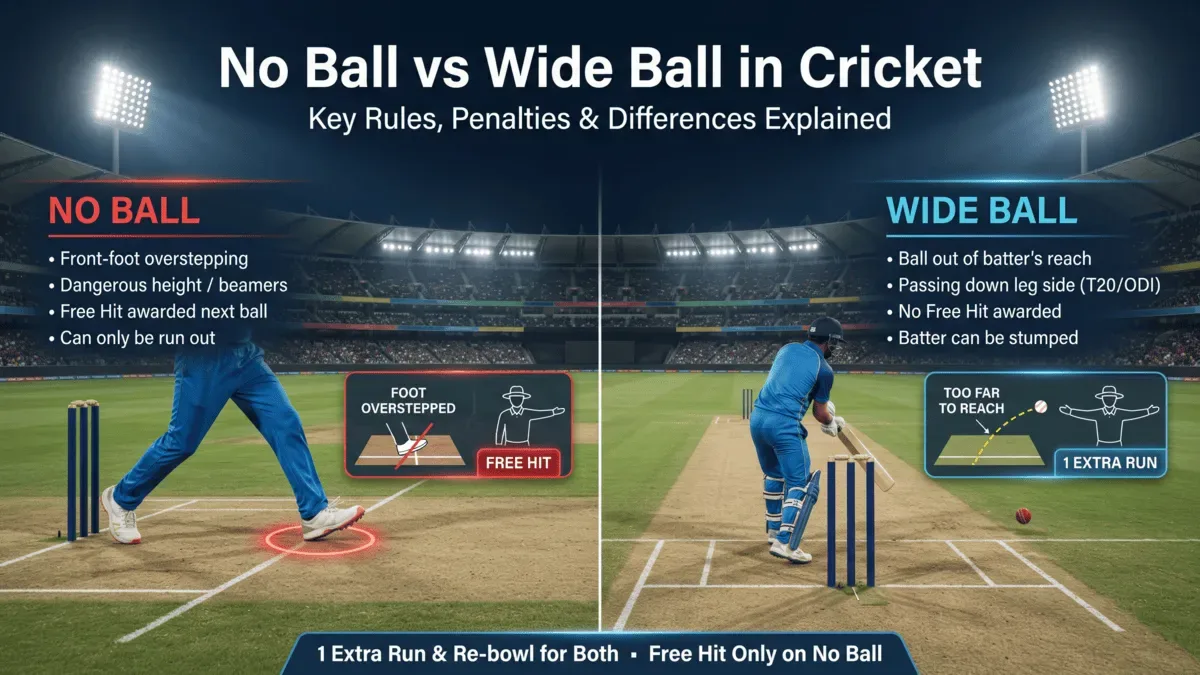
Both No Ball and Wide Ball are types of illegal deliveries in cricket. In each case, the batting side gains an extra run. However, there are key differences in their rules and implications.
Umpires frequently show a No Ball and/or Wide Ball in international, IPL and T20 cricket. Nevertheless, many people are often unsure as to when each of these is called.
Below we describe the key differences between No Balls and Wide Balls. We also detail their rules and outline the umpire signals, implications and effects on the bowling and batting sides.
What Is a No Ball in Cricket?
A No Ball is called when a bowler breaks bowling laws. Common causes of a No Ball include a front-foot which strays over.
The popping crease, as well as illegal bowling actions. Further causes can be the bowling of certain hazardous and unjust deliveries and/or breaking of fielding laws.
Following a No Ball, the batting side is awarded an extra run. Moreover, the delivery is not deemed to be a legal ball and so is not included in the overs’ six legal balls.
Main Reasons for a No Ball
The bowler oversteps the popping crease (no part of the front foot, grounded or raised, is behind the line
Bowling with an illegal action.
Bowling of hazardous and/or unjust deliveries.
Rolling of the ball or breaking of delivery laws.
Breaking fielding laws.
What Is a Wide Ball in Cricket?
A Wide Ball is called if the ball is too far away for a batter to strike in a usual manner. The umpire decides whether or not a delivery is too far for the batter to reach, taking into account the batter’s position and current playing conditions.
A Wide Ball can be called on either side of the batter. As with a No Ball, a batting side is awarded an extra run. Again, a Wide is not classed as a legal ball and so is not included in an over’s six legal balls.
Main Reasons for a Wide Ball
The ball passes down the leg side (outside the leg stump), out of the batter's reach.
The ball is too low on the leg side for the batter to hit in a usual manner.
The ball is too high for the batter to hit in line with the relevant laws.
Key Differences between a No Ball and a Wide Ball
| Feature | No Ball | Wide Ball |
|---|---|---|
| Meaning | Illegal delivery | Delivery outside batter's reach |
| Extra Runs | 1 run | 1 run |
| Counts in Over | No | No |
| Umpire Signal | One arm horizontally | Both arms horizontally |
| Free Hit | Usually in limited-overs formats | No automatic free hit |
| Common Reason | Front-foot infringement | Delivery too far from batter |
| Bowler Penalty | Extra charged to bowler | Extra charged to bowler |
No Ball Rules in Cricket
Laws relating to No Balls aim to stop unjust bowling and ensure a just battle between the bowling and batting sides.
Key points include:
1. Front Foot No Ball: A No Ball is awarded if the bowler’s front foot is in an illegal position and so strays Over.The popping crease.
2. Dangerous Bowling: Particular hazardous and unjust balls can also lead to a No Ball being called.
3. No Ball Extra: An extra run is awarded to the batting side upon a No Ball being called.
4. No Ball not Included in Over: As a No Ball is not a legal ball, the bowler must re-bowl.
5. Dismissal on a No Ball: Whilst most standard modes of dismissal are not available to batters following a No Ball, they can still be Run Out, Obstructing the Field or Hit the Ball Twice (subject to Laws of Cricket).
Wide Ball Rules in Cricket
Laws for Wide Balls seek to avoid bowlers sending down deliveries which are unjustly hard for batters to strike.
Key points include:
1. Extra Run
As with a No Ball, the batting side is awarded an extra run.
2. Wide not Included in Over
Similarly to a No Ball, a Wide is not one of an over’s six legal balls.
3. Extra Runs on a Wide
Further runs (both by running and via a boundary) can be added to the extra runs awarded for a Wide.
4. Stumping on a Wide
Providing the correct conditions are met, a batter can be stumped even on a Wide.
5. Revocation of a Wide
Should the ball make contact with the batter’s bat or body before reaching a fielder then a Wide must be revoked (depending on relevant law).
What Are the Umpire Signals for No Ball and Wide Ball?
Umpires display differing signals to show whether a No Ball or a Wide Ball has been called.
- No Ball: The umpire shows a No Ball by extending one arm horizontally.
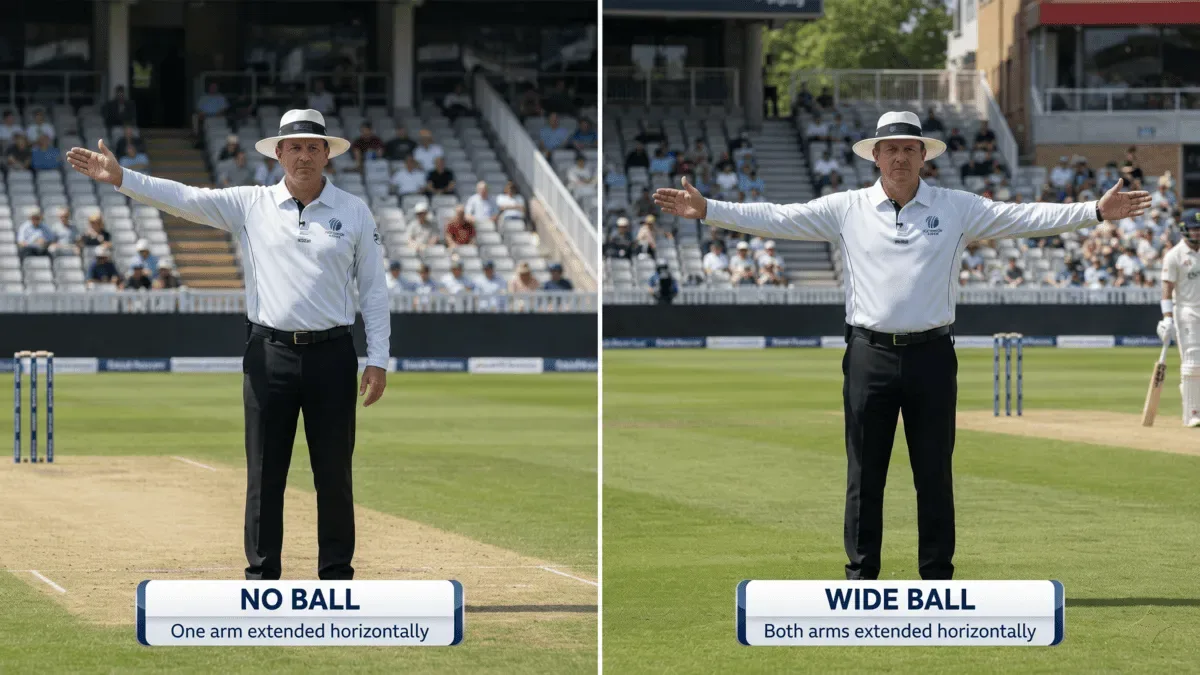
- Wide Ball: An umpire demonstrates a Wide Ball by extending both arms horizontally.
These signals enable players, scorers and spectators to recognise an umpire’s decision.
What Is a Free Hit After a No Ball?
A Free Hit is an extra shot which can be awarded to the batting side in limited overs international cricket and competitions such as the IPL, in specific cases when a No Ball is called.
During a Free Hit, most standard modes of dismissal are not available to batters. Generally, batters can only be dismissed in similar ways to those permitted on a No Ball, for example, via a Run Out.
If a Free Hit is itself a No Ball or Wide, then the subsequent delivery is still a Free Hit (depending on relevant playing conditions). However, a Wide Ball alone will not lead to a Free Hit.
Can a Batter be Dismissed on a No Ball or Wide Ball?
Yes, but with differing implications.
| Dismissal | No Ball | Wide Ball |
|---|---|---|
| Bowled | No | No |
| Caught | No | No |
| LBW | No | No |
| Stumped | No | Yes |
| Run Out | Yes | Yes |
| Hit Wicket | No | Yes |
| Obstructing the Field | Yes | Yes |
| Hit the Ball Twice | Yes | No |
This table summarises general Laws of Cricket. Specific playing conditions may also be in effect within a competition.
Which is More Expensive for a Bowler – a No Ball or a Wide Ball?
Both No Balls and Wide Balls incur a one run charge. Typically, these charges are levied at the bowler.
Nevertheless, in limited overs cricket, a No Ball can prove even more costly due to the possibility of a Free Hit also being awarded.
A Wide Ball can also be costly as further runs can be made and/or the ball may cross the boundary.
Consequently, both No Balls and Wide Balls can have an impact on a game – particularly in tight T20 matches.
Conclusion
No Balls and Wide Balls are significant within cricket. Both provide an extra run for the batting side and are not recognised as legal balls.
Whereas a No Ball is awarded for an illegal delivery or breach of bowling laws, a Wide Ball is called if a ball is too far for a batter to reach in a reasonable manner.
Having knowledge of these rules can therefore assist cricket enthusiasts in recognising and understanding umpire decisions, as well as general game events.
Explore Unkown Cricket Stats


Frequently asked questions
What is the difference between a No Ball and a Wide Ball?
A No Ball is an illegal delivery. A Wide Ball is one which is too far for a batter to reach in a reasonable manner.
How many runs are awarded for a No Ball?
One extra run is added to a batting side’s score for a No Ball. Further runs can also be made.
Can a batter be stumped on a Wide Ball?
Yes, A batter can be stumped on a Wide Ball if the correct conditions for a legal stumping are fulfilled.