Most Catches in Test Cricket History



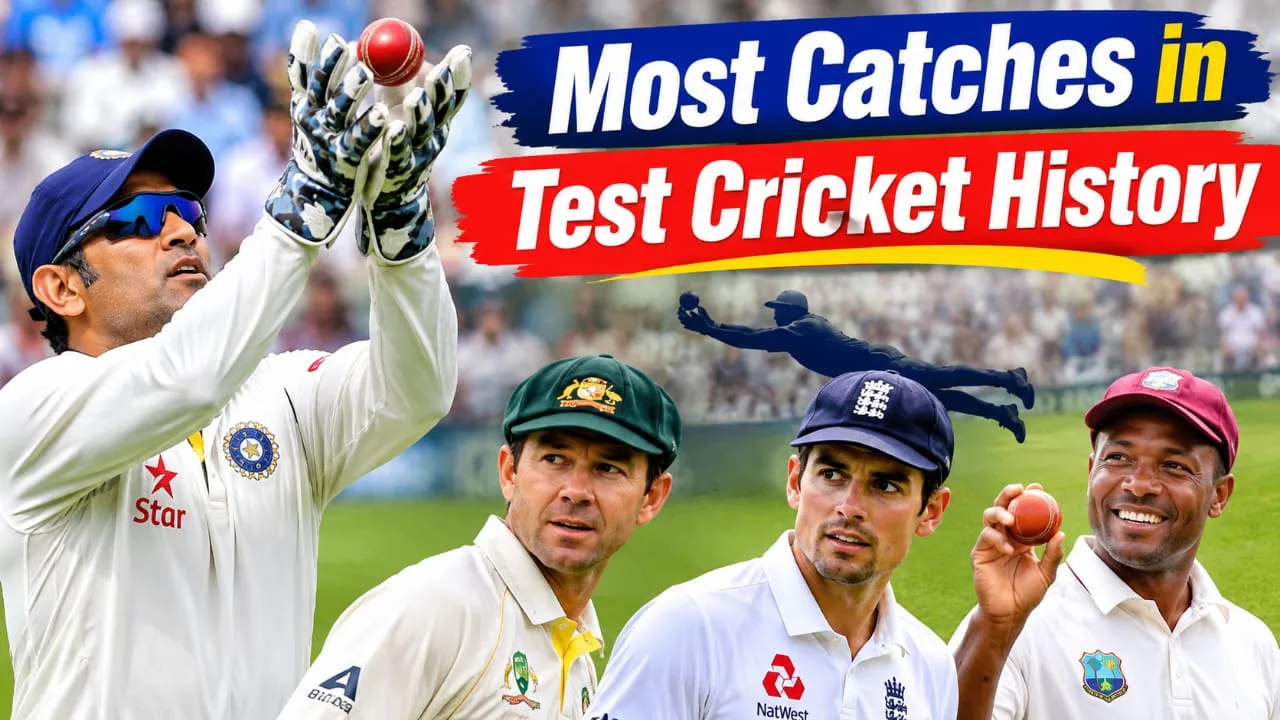
Test cricket is one of the most challenging formats of cricket. It tests a player's patience, skills, fitness, and concentration over five days. Batting and bowling are important, but fielding also plays a major role in winning matches. A single catch can change the result of a game.
Some of the greatest cricketers have taken hundreds of catches during their Test careers. Players like Steven Smith, Joe Root, Rahul Dravid, and Mahela Jayawardene are known for their excellent fielding skills. This article covers the most catches in Test cricket by non-wicketkeepers and explains the achievements of the leading players.
Statistics updated: 16 November 2026.
Most Catches in Test Cricket History
The record for the most catches in Test cricket by a non-wicketkeeper belongs to Australia's Steven Smith. He has taken 224 catches in Test matches. England's Joe Root follows him with 220 catches, while former Indian batter Rahul Dravid holds third place with 210 catches.
These players have shown excellent concentration and consistency throughout their careers. Here is the list of the top 10 players with the most Test catches as fielders.
| Rank | Player | Country | Test Catches |
|---|---|---|---|
| 1 | Steven Smith | Australia | 224 |
| 2 | Joe Root | England | 220 |
| 3 | Rahul Dravid | India | 210 |
| 4 | Mahela Jayawardene | Sri Lanka | 205 |
| 5 | Jacques Kallis | South Africa | 200 |
| 6 | Ricky Ponting | Australia | 196 |
| 7 | Mark Waugh | Australia | 181 |
| 8 | Alastair Cook | England | 175 |
| 9 | Stephen Fleming | New Zealand | 171 |
| 10 | Graeme Smith | South Africa | 169 |
Note: This ranking includes catches taken as a non-wicketkeeper fielder. Wicketkeeping catches are excluded.
1. Steven Smith – 224 Catches
Steven Smith holds the record for the most catches in Test cricket as a non-wicketkeeper. The Australian batter has taken 224 catches in Test matches.
Smith made his Test debut against Pakistan in July 2010. He became one of Australia's most important players through his batting and fielding performances.
He is especially effective in close catching positions, including the slips. His quick reactions and excellent hand-eye coordination help him take difficult catches. In October 2026, he moved ahead of Joe Root to take the top position in this record.
2. Joe Root – 220 Catches
Joe Root is one of England's greatest modern Test cricketers. He has taken 220 catches in Test cricket and holds second place on the all-time list.
Root made his Test debut against India in December 2012. He became a regular member of England's slip cordon because of his safe hands and quick reactions.
In July 2025, Root created history by taking his 211th Test catch against India at Lord's. With this catch, he moved ahead of Rahul Dravid, who had held the record with 210 catches.
Although Steven Smith has now moved ahead of him, Root remains one of the greatest fielders in Test cricket history.
3. Rahul Dravid – 210 Catches
Rahul Dravid is one of the greatest Indian cricketers of all time. He finished his Test career with 210 catches, making him the third-highest non-wicketkeeper catcher in Test history.
Dravid made his Test debut against England in June 1996. He was famous for his strong batting technique, patience, and discipline.
Apart from his batting, Dravid was also an excellent slip fielder. His record of 210 catches remained the highest in Test cricket until Joe Root passed it in 2025.
4. Mahela Jayawardene – 205 Catches
Mahela Jayawardene was one of Sri Lanka's finest batters and fielders. He finished his Test career with 205 catches.
Jayawardene played international cricket for many years and became an important part of Sri Lanka's middle order. His sharp reflexes and safe hands made him a reliable fielder.
He regularly helped his team by taking important catches in Test matches. His 205 catches place him among the greatest fielders in cricket history.
5. Jacques Kallis – 200 Catches
Jacques Kallis is considered one of the greatest all-rounders in cricket history. The former South African cricketer took 200 catches in Test cricket.
Kallis made his Test debut against England in December 1995. He was known for his outstanding batting, useful bowling, and excellent fielding.
His contribution was important in all three departments of the game. Reaching 200 Test catches shows how valuable he was as a fielder.
6. Ricky Ponting – 196 Catches
Ricky Ponting was one of Australia's most successful captains and batters. He finished his Test career with 196 catches.
Ponting was famous for his aggressive batting and strong leadership. He was also an outstanding fielder, particularly in close-catching positions.
His sharp reactions and attacking approach helped Australia take important wickets during many successful years.
7. Mark Waugh – 181 Catches
Mark Waugh was an important member of Australia's successful cricket teams during the 1990s and early 2000s. He took 181 catches in Test cricket.
Waugh was known for his stylish batting and excellent fielding. His catching ability made him one of the most dependable fielders of his generation.
He often took difficult catches that helped Australia control matches.
8. Alastair Cook – 175 Catches
Alastair Cook was one of England's greatest opening batters. He finished his Test career with 175 catches.
Cook made his Test debut against India in March 2006. He played 161 Test matches and scored more than 12,000 runs.
Although he was mainly known for his batting, Cook also made an important contribution in the field. His catching record places him among the top non-wicketkeeper fielders in Test history.
9. Stephen Fleming – 171 Catches
Stephen Fleming was one of New Zealand's most respected Test captains. He took 171 catches during his Test career.
Fleming was known for his batting and leadership skills. He played an important role in improving New Zealand's performance in international cricket.
His fielding ability also helped his team in difficult situations. He was a reliable catcher and an important part of New Zealand's fielding unit.
10. Graeme Smith – 169 Catches
Graeme Smith completes the top 10 list with 169 Test catches. He was one of South Africa's most successful Test captains.
Smith made his Test debut against Australia in March 2002. He was known for his strong batting and leadership skills.
He led South Africa in many important international matches. Along with his batting performances, his 169 catches show his contribution to the team's fielding efforts.
Why Are Catches Important in Test Cricket?
Catching is one of the most important parts of fielding in Test cricket. Unlike limited-overs cricket, Test matches span five days. Players need to maintain their concentration for long periods.
A good catch can help a team dismiss an experienced batter and change the direction of a match. Close fielders, especially slip fielders, need quick reactions because the ball can travel towards them in a fraction of a second.
Good fielding also puts pressure on the batting team. When fielders take difficult catches and stop runs, bowlers get more opportunities to take wickets.
Difference Between Fielding Catches and Wicketkeeping Catches
In cricket records, catches taken by regular fielders and wicketkeepers are generally shown in separate categories.
A non-wicketkeeper catch is taken by a player fielding anywhere on the ground, including the slips, gully, or other fielding positions.
A wicketkeeper catch is taken by the player standing behind the stumps. Wicketkeepers have their own records because they take catches and stumpings regularly.
For this reason, the ranking in this article includes only catches taken as a non-wicketkeeper fielder. This makes the comparison fair between specialist fielders.
Conclusion
Test cricket has seen many outstanding fielders who have taken hundreds of catches during their careers. Steven Smith leads the list with 224 catches, followed by Joe Root with 220 and Rahul Dravid with 210.
Mahela Jayawardene, Jacques Kallis, Ricky Ponting, and other legendary players have also made important contributions through their fielding.
These records show that catching is not just an additional skill in cricket. It is an important part of the game that can change match results and help teams achieve success.
Frequently asked questions
Who has taken the most catches in Test cricket history?
Steven Smith holds the record for the most catches by a non-wicketkeeper in Test cricket, with 224 catches as of 16 November 2026.
How many catches has Joe Root taken in Test cricket?
Joe Root has taken 220 catches in Test cricket, placing him among the leading fielders in the format.
Who is the first Indian player on the list of most catches in Test cricket?
Rahul Dravid is the leading Indian player on the all-time list, with 210 catches.
Are wicketkeepers' catches included in this record?
No. This record counts catches taken by fielders and excludes catches taken by wicketkeepers while keeping wickets.
Why are catches important in Test cricket?
Catches are important because they help dismiss batters and change the direction of a match. Good fielding can also build pressure on the batting team.