ICC Men's ODI Cricket World Cup Records: Top Teams & Big Wins



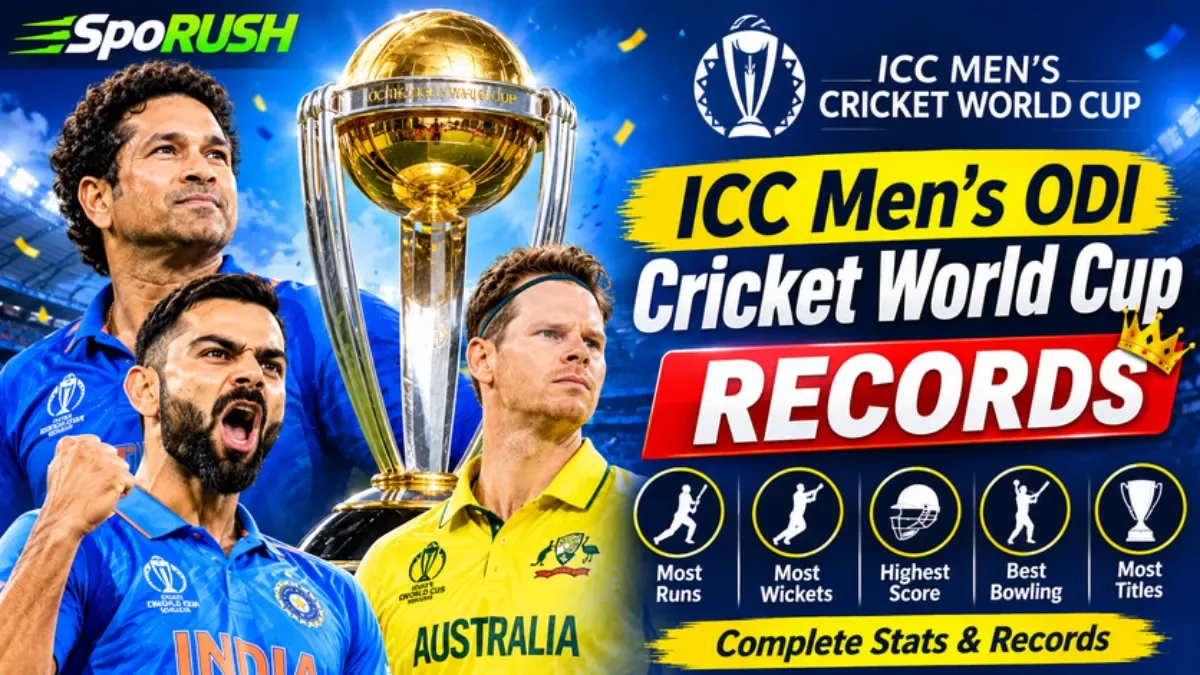
The ICC Men's ODI Cricket World Cup has set several key world records. Originally comprising just eight teams and played over 60 overs, the World Cup has progressed to include worldwide representation and is now played in 50 overs.
Playing styles, bowling, fielding and the conditions that teams play in have all contributed towards these sporting developments. Alongside Australia, which is currently the most successful team in World Cup history, a number of other countries have also created notable highlights throughout the years.
Most successful ODI World Cup teams
Australia is the most successful overall male team in World Cup history, having claimed six titles; these were in 1987, 1999, 2003, 2007, 2015 and 2023. Australia also had a dominant sequence of three back-to-back wins between 1999 and 2007.
Initially, the West Indies were the leading force in ODIs, claiming back-to-back World Cup wins in 1975 and 1979. India have also been successful twice, with wins in 1983 and 2011. Pakistan, Sri Lanka and England have also each won a World Cup – these were in 1992, 1996 and 2019 respectively.
Australia's impressive achievement of six World Cup wins and eight World Cup final appearances emphasises the team's long-term success. Likewise, India also showed strong historical success as they have won two World Cups, with a home win in 2011.
Highest team scores in ODI World Cups
As an attacking style of play has developed, so too has the scoring in World Cups. South Africa's score of 428/5 against Sri Lanka in Delhi in 2023 was the highest team score in World Cup history.
Previously, Australia had held the record for the highest team score, making 417/6 against Afghanistan in the 2015 World Cup. India have also featured in the top group for team scores, with a 413/5 score against Bermuda in 2007. This then demonstrates how effective a team can be when their openers, middle-order and lower order can all contribute highly.
Furthermore, South Africa's attacking style shone in the 2023 World Cup. They managed to score four scores of over 350 in that year and also hit the highest number of sixes (99) by a team in World Cup history.
Lowest team scores and highest margins of victory
Whilst high team scores are key factors in World Cup successes, so too are low team scores and the rapid disintegration of a team's batting. Canada's 36 all out against Sri Lanka in 2003 is still the lowest team score in men's ODI World Cup history.
Australia also achieved the largest margin of victory in the 2023 World Cup, winning by 309 runs against the Netherlands. India too had a highly successful margin of victory in 2023, defeating Sri Lanka by 302 runs.
Whilst large margins often result from high team scores and good bowling control, they can also highlight the varying levels of depth, experience and composure that can exist within competing teams in high-pressure World Cup situations.
Batting achievements and styles
As mentioned above, batting styles in contemporary ODIs have become more attacking. With reference to powerplay overs, attacking middle order and exciting finishes, teams have modified their batting strategies.
Virat Kohli scored the most runs by an individual batter in a single men's ODI World Cup edition, finishing the 2023 tournament with 765 runs. He broke the previous record of 673 runs, set by Sachin Tendulkar during the 2003 World Cup.
Kohli's batting further illustrated that the ability to adapt one's batting to different situations is key. Throughout the 2023 World Cup, he produced a number of outstanding scores, such as his century in the semi final against New Zealand. Likewise, South Africa's batting team showcased how beneficial it can be for a team for all of its members to make significant batting contributions. South Africa's batters collectively scored nine individual centuries during the 2023 World Cup, the highest tally by a team in a single edition.
This therefore suggests that although there are various ways in which a team can be a high scoring entity, it is also essential for a team to possess individuals that can both steadily and pressurisingly bat and then speed up their scoring when required.
Bowling achievements and influence
As with batting, bowling is a fundamental component of World Cup success, especially within knockout games and whilst chasing a target. Glenn McGrath's 7/15 performance against Namibia in 2003 is one of the most exceptional individual bowling feats in World Cup history.
Mohammed Shami had an equally impressive year in the 2023 World Cup. He was the quickest bowler to 50 World Cup wickets, in 17 innings, and furthermore was the first bowler to achieve three five wicket hauls in one men's ODI World Cup. He also took 24 wickets in that year's tournament.
Adam Zampa then equalled Muttiah Muralitharan's record of being the highest wicket scoring spinner in one World Cup, with 23 wickets in 2023. Despite teams frequently scoring highly in World Cups, these bowlers' achievements clearly highlight the impact that good bowling can have.
Alongside run control, modern ODI bowlers need to effectively vary their pace, utilise spin and bowl accurately in the death overs. Bowlers should also be adept at breaking batting partnerships at key points in games.
Fielding and wicket keeping
Excellent fielding has also become a key area for assessing World Cup teams. Key run-outs, boundary stops and catching can all be pivotal in deciding the outcome of tight games. Teams often benefit from good fielding as it both stops extra runs from being scored and presents good wicket taking opportunities.
The 2023 World Cup again underlined the importance of wicket-keeping batsmen. South Africa's Quinton de Kock was the first player to score 500+ runs and register 20+ dismissals in the same World Cup edition, with a total of 594 runs and 20+ dismissals.
This therefore exemplifies how wicket keepers can excel in both batting and dismissal taking. As such, a team's wicket keeper cannot simply be assessed using only batting data as their catching and stumpings can also greatly affect the team's performance.
Evolution of World Cup performance
Throughout the years there have been a number of developments that have altered World Cup performance. In 1987, the 60-over structure was replaced with 50-over cricket. Further modifications to the World Cup included the introduction of coloured clothing, white balls and day/night games in the 1990s.
Recently, teams have increasingly adopted attacking openers, adaptable middle order and proactive field positions. Again, the 2023 World Cup highlighted this through the attainment of record scores, centuries and excellent bowling performances.
Nevertheless, well-performing teams still utilise well-rounded skill-sets. Good depth, quality bowling and strong fielding are all key to success irrespective of conditions and format.
Insights into successful World Cup teams
Statistics from World Cups illustrate that there is no single determinant of ongoing team success. Australia's six World Cup wins represent their long-term success, and alongside India's two wins and the successes of the West Indies, Pakistan, Sri Lanka and England, they encapsulate the highly-competitive nature of World Cups.
Team scores provide information about evolving batting styles. Bowling statistics then emphasise the continued significance of good wicket taking in key moments. Finally, fielding and wicket keeping statistics provide further insights into team performance.
Therefore, to properly analyse World Cup teams it is important to assess their World Cup titles, match outcomes, scoring, bowling and fielding performance. Such data then provides improved understanding of how teams have adapted to the altering nature of ODI cricket.
Related Cricket Statistics & Records


Frequently asked questions
Which team has the most ICC Men's ODI Cricket World Cup wins?
Australia has the highest number of ODI World Cup wins, with a total of six (1987, 1999, 2003, 2007, 2015 and 2023).
What is the highest team score in ODI World Cup history?
South Africa scored the highest team score in World Cup history, 428/5, against Sri Lanka in the 2023 ODI World Cup in Delhi.
Who has the highest individual score in a single ODI World Cup edition?
Virat Kohli attained the highest individual score in the 2023 ODI World Cup, with 765 runs.
Which team has had the greatest margin of victory in ODI World Cup history?
Australia had the highest margin of victory in the 2023 World Cup, winning by 309 runs against the Netherlands.
Who has the best bowling figures in an ODI World Cup game?
Glenn McGrath holds the record with figures of 7 wickets for 15 runs against Namibia in the 2003 ODI World Cup.