Don Bradman Biography: Age, Family, Career and Records



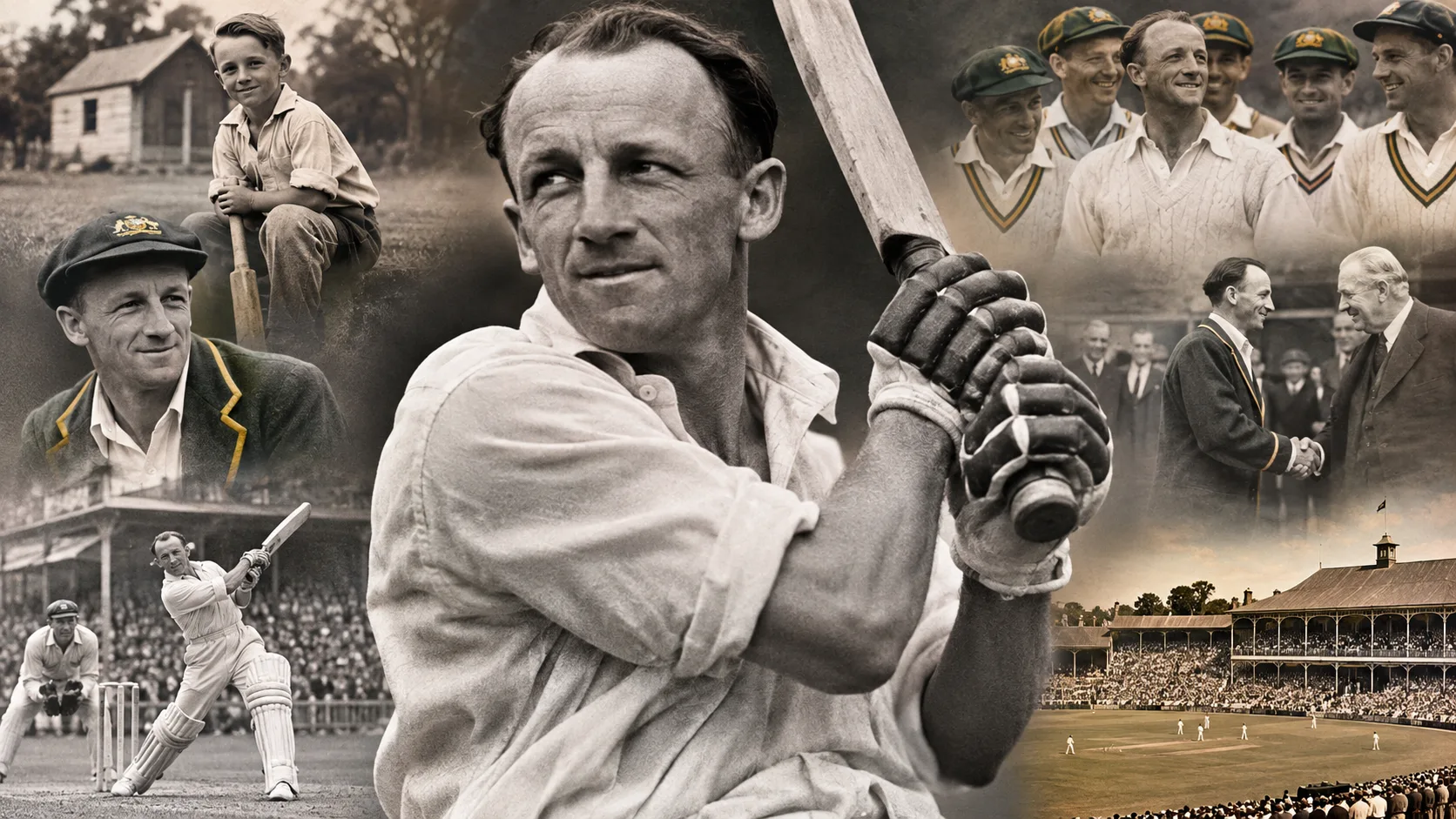
Sir Donald George Bradman was an Australian cricketer whose extraordinary batting made him one of the greatest players in the history of the game. Representing Australia in international cricket, Bradman became famous for his remarkable consistency, hunger for runs and unmatched Test batting average of 99.94.
Don Bradman's early life and family
Sir Donald George Bradman was born on 27 August 1908 in Cootamundra, a small town in New South Wales, Australia. He was the youngest of five children born to George Bradman, a farmer, and Emily Bradman, née Whatman. Cricket would eventually take him around the world, but his early years were spent far from the big grounds and crowds that later became part of his life.
When Don was still a young child, the family moved to Bowral in 1911. It was here, in the quiet surroundings of the Southern Highlands, that his interest in cricket began to grow. His father was a keen local cricketer and worked as a carpenter. Two of his maternal uncles, Richard and George, were also involved in local cricket and helped introduce him to the game. His mother would bowl to him after school, giving the youngster another chance to spend time with a bat and ball.
Bradman attended Bowral Public School and later Bowral High School. He was interested in more than just cricket. Music was also part of his childhood, and he learnt to play the piano with help from his sister Lilian. But it was the game with the bat that gradually took over most of his attention.
One small detail from those years says a lot about his determination. When there was nobody available to bowl to him, Bradman found his own way to practise. He picked up a shortened cricket stump and used it as a bat, hitting a golf ball against the brick base of a water tank in the backyard. The ball would rebound, giving him another chance to play a shot. He repeated this exercise for hours, working on his timing and control without needing another player.
His ability soon became visible in school cricket. At the age of 11, he scored 55 not out in his first competitive match for his primary school. The following season, playing for his high school against Mittagong, he made 115 runs. It was his first century, and a remarkable sign of what was coming. By then, Bradman was no longer just a boy practising in his backyard; he was beginning to make a name for himself in local cricket.
In February 1921, his father took him to the Sydney Cricket Ground to watch the fifth Test between Australia and England. It was a memorable experience for the young Bradman. He had the chance to see Test cricket at close quarters, and the SCG would remain his favourite ground throughout his playing career.
How the cricket career began
Bradman did not come through a famous cricket academy or a formal coaching system. His early development happened in Bowral, where he played local cricket and learned largely through regular practice and experience. His father, George Bradman, was a keen cricketer, while local cricket figures such as Alf Stephens also helped him find opportunities to play. By the 1925–26 season, Don had become a regular member of the Bowral team in the Berrima District competition.
One innings in particular brought him into wider attention. On 9 January 1926, Bradman scored 234 against Wingello, a team that included the young leg-spinner Bill O'Reilly, who would later become his Australian teammate. He continued making big scores that season, including 105, 120 and 300 against Moss Vale. Across the Berrima District competition, he finished with 1,318 runs at an average of 94.14. Those numbers were difficult for selectors to ignore.
His performances earned him an invitation to attend a trial with New South Wales players at the Sydney Cricket Ground in October 1926. Soon afterwards, he joined St George District Cricket Club, making his first-grade debut in November 1926. Travelling from Bowral to Sydney for matches was not easy; he often had to catch an early train and return home late at night. But the opportunity was worth the effort.
Bradman moved into state cricket with New South Wales during the 1927–28 season. His first-class debut came against South Australia at the Adelaide Oval on 17 December 1927. He had originally been named as twelfth man, but an injury to Archie Jackson opened the door. Bradman took his chance immediately, scoring 118 runs in his first innings. Making a century on first-class debut was a major achievement, especially for a 19-year-old playing his first match at that level.
There was no Under-19 World Cup pathway in Bradman's playing era, so he did not have an Under-19 international career in the modern sense. His rise came through school cricket, country cricket, club cricket and then the Sheffield Shield. By the end of his first season with New South Wales, he had already shown that his scoring ability was not limited to local competition. The boy from Bowral was now making an impression on Australia's bigger cricket stage.
Don Bradman's international career
Don Bradman made his Test debut for Australia against England at the Brisbane Cricket Ground on 30 November 1928, during the Ashes series. It was not the start he would have wanted. He scored 18 in the first innings and just one in the second as England secured a heavy victory. He was left out of the next Test, but the setback did not last long. Australia brought him back for the Melbourne Test, where he responded with a determined innings and scored his first Test century.
His career took a different turn during the 1930 Ashes tour of England. Bradman arrived as a young Australian batsman, but by the end of the series, English cricket had a serious problem to think about. At Lord's, he produced an innings of 254, which he later described as the finest technically of his career. Then came Headingley. Bradman scored 334 in a single innings, including a remarkable 309 runs in one day. That performance established him as the leading batting force of his generation.
The 1932–33 Ashes series in Australia became one of the most controversial chapters of his career. England, under Douglas Jardine, used the Bodyline tactic, with fast bowlers targeting the body and leg side of the Australian batsmen. Bradman was the main target of the plan. The series went beyond ordinary cricket rivalry, creating serious debate about the spirit and safety of the game. Australia lost the series, but the controversy left a lasting mark on cricket history.
Bradman continued to produce major performances in the years that followed. During the 1934 Ashes in England, he scored a triple century at Headingley despite struggling with illness. In the 1936–37 series against England, now leading Australia as captain, he played a remarkable innings of 270 at Melbourne after his team had been pushed into a difficult position. It became one of the defining performances of his captaincy.
World War II interrupted international cricket, and Bradman did not play Test cricket during the war years. When the game returned, he was back in the Australian side. His final major chapter came during the 1948 tour of England, when he captained the famous Australian team known as The Invincibles. The side completed the tour without losing a match, a remarkable achievement that strengthened Bradman's legacy as a leader as well as a batsman. His final Test appearance came at The Oval in August 1948.
Bradman's international career was closely tied to the Ashes, but his influence reached far beyond one rivalry. His performances against England, his response to the Bodyline attack and his leadership of The Invincibles remain central chapters in the history of Australian cricket.
IPL and domestic cricket
Don Bradman's domestic career was built around two Australian state teams: New South Wales and South Australia. He began playing for New South Wales during the 1927–28 season and represented the state until the end of the 1933–34 season. His move to Adelaide brought a new chapter. From the 1935–36 season, he played for South Australia and remained associated with the team until his retirement from first-class cricket.
The move was not simply a change of team. Bradman had settled in Adelaide and was also building a career outside cricket as a stockbroker. In South Australia, he became captain and a state selector. He led the side through several seasons and helped it compete strongly in the Sheffield Shield. His leadership was not limited to the state team; he later became one of the most influential captains in Australian cricket.
Bradman first captained Australia during the 1936–37 Ashes series against England. He continued to lead the national side on major tours, including the 1938 tour of England and the post-war series. His final assignment as Australian captain was the famous 1948 tour of England, when his team completed the journey unbeaten. That side became known as The Invincibles.
There is no IPL team or auction price to mention in Bradman's case. The IPL began decades after his retirement and death, so he never played franchise T20 cricket. His domestic legacy belongs to the Sheffield Shield era, particularly his years with New South Wales and South Australia.
Playing style
Don Bradman's greatest strength was his ability to read the ball early and adjust his shot at the last moment. His batting technique looked unusual compared with the coaching methods of his time, but it gave him tremendous freedom at the crease. He had quick feet, excellent balance and an unusual ability to move forward or go deep into the crease depending on the length of the delivery. Even when a bowler tried to surprise him, Bradman could change his stroke without losing control.
The pull shot was one of his most recognisable strokes. He played it with remarkable control, often sending the ball through the leg side rather than simply hitting it into the air. The hook and cut were also important parts of his game. In fact, footage preserved by the National Museum of Australia highlights his pull shot and the way he moved his back foot across the crease to get behind the ball.
Bradman was not just a back-foot player. When bowlers dropped the ball short, he could punish them with the pull, hook or cut. If they pitched it up, he was equally comfortable coming down the pitch and driving through the field. His unusual backlift, directed towards the slips rather than straight behind him, helped him play a wide range of strokes. It was a method he developed through years of practice, not something he changed simply to satisfy conventional coaching advice.
He was especially dangerous once he had settled at the crease. A bowler might keep him quiet for a few deliveries, but giving him even a little room or missing the length could quickly change the situation. His concentration allowed him to bat for long periods, while his attacking instincts meant he rarely allowed the fielding side to relax. England's Bodyline plan during the 1932–33 Ashes was designed largely to restrict his scoring and exploit the short ball, showing just how seriously opponents viewed his batting threat.
Bradman's game was not built around one spectacular stroke. It was the combination of sharp judgement, fast footwork, unusual technique and relentless run-scoring that made him so difficult to contain. He could attack without appearing reckless, and that balance was perhaps his most dangerous quality.
Achievements and records
Don Bradman's achievements went far beyond the runs he scored. He dominated batting during an era when bowlers had plenty of ways to challenge a batsman, yet he kept finding answers. His consistency was remarkable, and his influence on Australian cricket grew with every passing season. Even today, his name remains central to conversations about the greatest batsmen the game has seen.
One of the defining moments of his career came in 1948, when he led Australia on the famous tour of England. The team went through the entire tour unbeaten and earned the name The Invincibles. Bradman also received recognition beyond the cricket field, including a knighthood for his services to the game. His records and honours reflect a career that left a lasting mark on cricket.
Don Bradman's Achievements at a Glance
Test Batting Average: 99.94
Test Centuries: 29
Test Double Centuries: 12
Test Triple Centuries: 2
The Invincibles (1948): Captained Australia on its unbeaten tour of England.
Knighthood (1949): Became the first Australian cricketer to receive a knighthood.
Companion of the Order of Australia (1979): Recognised for his contribution to cricket.
Australian Cricket Hall of Fame: Inducted in 1996.
Wisden Cricketer of the Century: Selected in 2000.
ICC Cricket Hall of Fame: Inducted in 2009.
Personal life
Away from cricket, Don Bradman preferred a quiet family life. He married Jessie Martha Menzies on 30 April 1932 at St Paul's Church in Burwood, Sydney. The two had known each other since childhood, having met in Bowral when they were still school students. Their relationship lasted for 65 years, and Bradman often spoke warmly about the support Jessie gave him throughout his career. He once described their marriage as “the best partnership of my life.”
The couple had three children. Their first son, Ross, was born in 1936 but died just two days later. Their second son, John, was born in 1939, followed by their daughter, Shirley, in 1941. John suffered from polio during childhood but recovered and later made his own name in athletics. Shirley had cerebral palsy. Bradman was deeply attached to his family, although the attention surrounding his fame sometimes made ordinary family life difficult.
Bradman was not someone who enjoyed constant public attention. After retiring from cricket, he spent much of his time in Adelaide, working in business and enjoying golf, gardening, bridge and music. He was also a capable piano player, a skill he had developed as a boy with help from his sister. Jessie died in 1997, and Bradman died in Adelaide on 25 February 2001.
Social media did not exist during Bradman's lifetime, so he never had personal accounts on platforms such as Instagram, Facebook or X. Today, his memory is kept alive through the Bradman Museum and the Bradman Foundation in Bowral, where visitors can explore his career, personal memorabilia and contribution to cricket.
Frequently asked questions
When and where was Don Bradman born?
Don Bradman was born on 27 August 1908 in Cootamundra, New South Wales, Australia.
Which team does Don Bradman play for?
Don Bradman represented Australia in international cricket. At domestic level, he played for New South Wales and South Australia.
When did Don Bradman make the international debut?
Don Bradman made his Test debut for Australia against England on 30 November 1928 at the Brisbane Cricket Ground during the Ashes series.